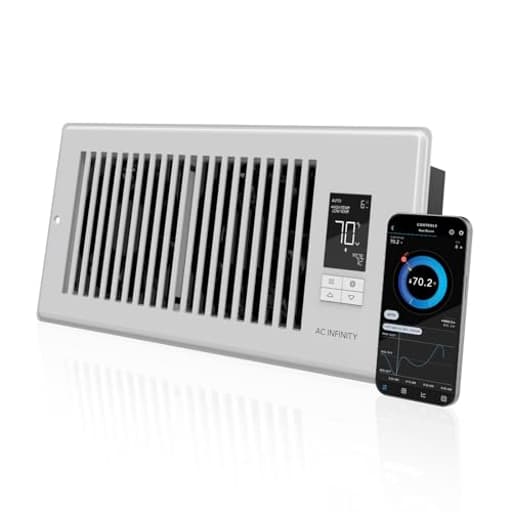
Features
- A register fan designed to boost and improve existing airflow from register holes in home HVAC systems.
- Smart controller features 10-level speeds, heating and cooling triggers, and timer and cycle programming.
- Connect to our app via Bluetooth to unlock advance programs, set alarms & notifications, and view climate data.
- Premium anodized aluminum frame with CNC-machined detailing for a flush and clean appearance.
- FITS ONLY 4 x 10 in. REGISTERS | Rear Casing: 3.93 x 9.76 in. | Engine: Dual 92 mm | Airflow: 130 CFM | Noise: 17 Dba | Color: White
Specifications
| Color | White |
| Size | 4” x 10" |
Related Tools
A register-mounted booster fan designed to fit only 4 x 10 inch HVAC registers, used to increase airflow from heating and cooling vents. It employs dual 92 mm fans rated up to 130 CFM at about 17 dBA, features a 10-speed controller with heating/cooling triggers, timers and cycle programming, Bluetooth app connectivity for advanced programs, alerts and climate data, and an anodized aluminum frame with CNC-machined detailing for a flush installation.
AC Infinity AIRTAP T4 White, Register Booster Fan for 4” x 10” Register Holes, Improves Heating & Cooling Vents, Quiet 10-Speeds, Bluetooth App Control Data Alerts. ONLY FITS 4” x 10” Duct Openings Review
Why I reached for a register booster
The hottest room in my house finally feels like the rest of the house. In my case, it’s a west-facing bedroom at the far end of the duct run with a single 4 x 10 floor register and too many elbows in the line. I tried the usual tricks—closing nearby dampers, running the air handler constantly, adding a fan in the doorway—none of which were satisfying or efficient. The AIRTAP T4 was the first fix that consistently moved the needle without turning the rest of the home into a wind tunnel.
This is a register-mounted booster, not a duct inline fan. It replaces your existing grille, adds two quiet 92 mm fans under an aluminum faceplate, and actively pulls air out of the duct to the room. It looks like a regular register, but smarter.
Installation and setup
Install was refreshingly simple:
- Measure first. The T4 only fits 4 x 10 inch openings. The rear casing is roughly 3.93 x 9.76 inches; if your cutout is ragged or undersized, you’ll want to square it up.
- Drop-in and plug-in. Remove the old grille, set the AIRTAP into the opening, and plug it into a nearby outlet.
- Pair over Bluetooth with AC Infinity’s app for easier configuration than using the onboard buttons.
I had mine running in under five minutes. The faceplate sits flush and looks cleaner than the stamped steel register it replaced. Because it needs power, plan where the cord will go—especially on floor installs. I used a low-profile cord cover along the baseboard to keep it away from feet and pets.
Controls and app
The integrated controller has ten fan speeds and multiple modes (On, Off, Auto, Timer, Cycle). The Auto mode is the reason to buy this device; it uses a built-in probe to detect supply-air temperature and decides whether your system is heating or cooling.
A few practical notes from setup:
- Auto is two-threshold. You choose a “cold” threshold for cooling and a “hot” threshold for heating. The sensor reads supply air, not room air, so setpoints should reflect typical vent temps (e.g., cool air around the low 60s F; warm air in the 90s–100s F range, depending on your system).
- Minimum speed matters. By default, the AIRTAP can idle at a low speed even between HVAC cycles. If you want it fully off between cycles, set the “Min” speed to 0 in Auto mode.
- The app is the way to go. Programming is possible on-device, but the phone interface makes it faster to set thresholds, schedules, and fan curves, and to review temperature history. It’s Bluetooth-only (no Wi‑Fi), so you need to be within range.
Once configured, I barely touched it beyond occasional speed tweaks on extreme days.
Performance in the real world
The difference at the register is immediate and obvious. On my problem vent, air moved from a faint whisper to a steady, directed stream. With a handheld anemometer, I saw a clear jump in air velocity; more importantly, the room stopped lagging the hallway by several degrees. On typical summer afternoons, the bedroom settled within a comfortable margin of the thermostat setting and stayed there into the evening—without running the central fan constantly.
Some observations after living with it:
- It doesn’t create airflow; it leverages what you already have. If the duct is pinched or blocked, a booster won’t fix that. But on long runs and rooms starved by static pressure, it makes the most of each cycle.
- It helps in both seasons. In winter, I used a higher “hot” threshold, and the AIRTAP prolonged useful warm airflow after the main blower shut off, which took the edge off cold corners.
- It mixes air better. The vertical discharge throws air upward, which helped eliminate that stagnant layer of warm air that used to sit in the upper half of the room.
I mostly run it at speeds 4–6. That’s the sweet spot where airflow is meaningfully boosted and noise remains easy to ignore. On oppressive days, bumping to 7–8 cools the room quickly, then I drop it back.
Noise and comfort
At low to mid speeds, the sound profile is a gentle whoosh similar to a quiet PC. Above 6, it becomes clearly audible; above 8, it’s white-noise territory. There’s no rattling or tonal whine in my unit—just airflow. I wouldn’t run it at 9–10 during a quiet movie night, but for sleeping, the white noise is actually pleasant.
If you’re sensitive to sound, plan to:
- Use Auto with a lower Max speed for overnight operation.
- Create a simple schedule in the app to ramp up during the day and drop at night.
- Ensure the register sits flat and sealed to avoid vibrations. A thin foam gasket or painter’s tape can help on uneven openings.
Build quality and design
The anodized aluminum faceplate looks and feels premium, and the CNC-machined vents strike the right balance between airflow and a clean, minimalist look. The fit is tight, the fans are well-secured, and the cable strain relief is robust. It’s the rare smart home accessory that actually upgrades the look of the room rather than adding visual clutter.
Aesthetic aside, durability seems solid. After weeks of daily use—including running long hours during a heat wave—there’s no bearing noise, no controller glitches, and no drift in the temperature readings.
Energy use
The draw is modest—think small electronics, not appliances. Leaving it in Auto or at a moderate fixed speed added an almost negligible amount to my energy use yet cut down on the temptation to run the central fan continuously just to help one room. That’s the bigger win: targeted comfort without forcing the whole system to work harder than necessary.
Limitations and considerations
- Size compatibility only. It fits standard 4 x 10 inch registers. Measure the opening, not the old grille, and confirm there’s enough unobstructed space below for the fan housing.
- It needs an outlet. Plan cable routing, especially for floor vents in open spaces.
- Programming has a learning curve. The Auto thresholds make perfect sense once you remember they’re vent temperatures, not room temperatures. The app makes this a non-issue, but the on-device buttons are a bit fiddly for initial setup.
- It won’t fix bad ductwork. Crushed flex, disconnected runs, or severely unbalanced systems need real HVAC attention. The AIRTAP is best seen as a smart band-aid that often delivers a big comfort boost for a fraction of the cost of ductwork changes.
Tips for dialing it in
- Start with Auto, Min speed 0, Max speed 5 or 6.
- Set cold/hot thresholds after observing typical vent temps during a cycle (peek at the live reading in the app).
- If you hear the fans running between cycles and don’t want that, double-check the Min speed.
- In multi-story homes, use higher speeds briefly to “charge” the room before bedtime, then step down to reduce noise.
Who it’s for
- Rooms at the end of a duct run that lag behind the thermostat setting.
- Upstairs bedrooms that run hot in summer or cold in winter.
- Home offices and attic conversions with poor supply airflow.
- Renters or anyone who can’t alter ductwork but needs a reversible comfort fix.
If your home is already well-balanced, you won’t see dramatic improvements. But in typical homes with one or two stubborn rooms, this is a practical, tidy solution.
Recommendation
I recommend the AIRTAP T4. It’s thoughtfully built, simple to install, and, most importantly, it works in the scenario it’s designed for: boosting weak vents to make stubborn rooms comfortable. The 10-speed control and Auto mode let you find a balance of airflow and quiet, the Bluetooth app removes the friction from setup, and the aluminum faceplate looks better than the register it replaces. It’s not a cure-all for bad duct design, and you’ll need to manage a power cord, but as a targeted, low-power fix for an unbalanced HVAC system, it earns its spot.
Project Ideas
Business
Smart Vent Retrofit Service
Offer a local service that diagnoses low-air rooms and installs AIRTAP T4 units. Package includes room airflow measurements, placement strategy (only fits 4x10 registers), app configuration (triggers/timers), and a post-install optimization report showing improvements and energy estimates. Sell single-room fixes or whole-home zoning packages.
Designer Register Covers + Install
Produce a line of custom CNC-anodized decorative faceplates and complementary finishes that integrate seamlessly with the AIRTAP frame. Target interior designers, builders and luxury remodels who want performance (130 CFM, 17 dBA) without compromising aesthetics. Offer installation and color-matching as an upsell.
Airbnb / Short-Term Rental Comfort Package
Market a comfort/energy package for hosts: install booster fans in problem rooms, preconfigure schedules for guest check-in/out, and enable remote control so hosts can adjust temps between stays. Emphasize quiet operation for bedrooms and quicker guest comfort without raising whole-house HVAC costs.
Monitoring & Preventive Maintenance Subscription
Use the Bluetooth app data and alerts to sell a subscription that monitors vent performance: receive notifications for abnormal climate readings, fan faults or reduced airflow. Include annual vent cleaning, battery checks on any sensors, and discounted replacement units. This turns a one-time install into recurring revenue.
HVAC Auditor Partnership & Retrofit Sales
Partner with energy auditors and HVAC contractors to offer AIRTAP installs as a low-cost retrofit for rooms that under-deliver air. Auditors can include the booster solution in efficiency reports and contractors can upsell installation rather than recommending expensive duct redesigns. Provide bundled pricing, installer training, and co-branded marketing materials.
Creative
Micro Zoning Build
Turn the 4x10 booster into a modular micro-zoning unit: mount the fan into a custom wooden/framed register box with removable panels and a small temp sensor. Use the app's heating/cooling triggers and timers to make the fan run only when a room deviates from setpoint. Good for workshops, nurseries or single bedrooms where a full HVAC rework would be overkill.
CNC Decorative Vent Art
Leverage the anodized aluminum frame and chrome finish as a starting point for a decorative vent panel. CNC-cut or laser-etch a custom faceplate (geometric, floral or logo) that snaps over the AIRTAP T4, leaving airflow channels. The fan provides real functionality while the face becomes a design piece—add a thin RGB LED ring for accent lighting and use the app to schedule quiet nighttime speeds (17 dBA).
Closet / Electronics Cooling Hatch
Build a ventilated hatch or faux-register into a small server, AV or electronics closet using the 4x10 booster fan to actively remove heat. Program the fan to trigger at set temperatures via the app so it runs only when electronics get warm. The unit's low noise and 130 CFM airflow make it ideal for concealed quiet cooling.
Pet Comfort Venting Nook
Create a cozy pet nook that uses warmed/cooled air from a nearby register routed through a padded box where the AIRTAP sits flush in the opening. Use the 10-speed controller and timers to gently circulate conditioned air while pets nap; add a washable cushion and a small scent-neutralizing insert. Nice for senior pets who need stable temps.
Micro-Grow Cabinet Climate Controller
Install the booster fan into a custom 4x10 cutout on a small grow cabinet or hydroponic box to improve circulation and reduce hot spots. Use the app's climate data and triggers to cycle the fan based on temperature or scheduled light phases, improving airflow without noisy, oversized fans.