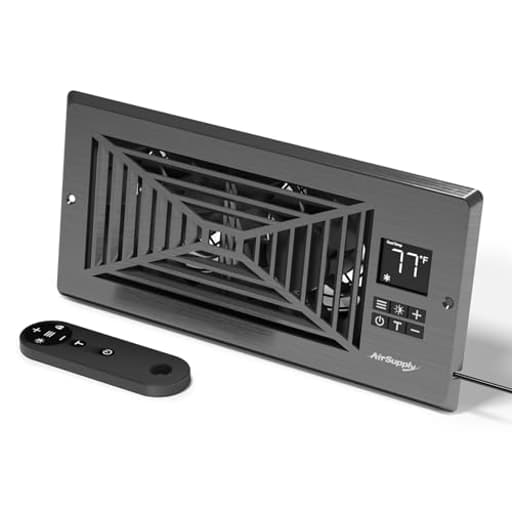
Features
- 【Enhanced Energy Efficiency】Boost the performance of your existing heating and cooling system by improving air circulation for quicker and more even temperature distribution, keeping you comfortable and saving energy.
- 【Intelligent Controls】Benefit from a built-in temperature probe, the fan reacts intelligently. It runs if the airflow’s temp. falls below or rises above the cooling or heating trigger’s setting respectively. A programmable LCD controller with 6 buttons offers intuitive operation. Note: The set temp. only triggers the fan to work and is NOT your room temp. or desired temp.
- 【High-Powered Airflow】A maximum airflow of 180CFM surpasses other brands’ by 50%, providing higher airspeed and further coverage, making it great for larger spaces. Choose from 10 fan speeds or use the TURBO function for the highest speed with just one press.
- 【Versatile Four-Way Vent Grille】Designed to fit 4’’x10’’ registers on either the wall or the floor. The 4-way vent grille is uniquely crafted at a 45° angle to facilitate airflow in all four directions, optimizing circulation in any room.
- 【Where To Use】This booster fan is specifically engineered for aging central air systems, situations where registers are distant from the main HVAC unit, or cases where multiple rooms rely on the same HVAC unit.
Specifications
| Color | Grey |
| Size | 4'' x 10'' |
| Unit Count | 1 |
Related Tools
A register booster fan that fits 4" x 10" wall or floor registers to increase HVAC airflow and improve circulation and temperature distribution. It has a four-way 45° vent grille, a 10-speed fan with a turbo high-speed mode (up to 180 CFM), a programmable LCD controller with built-in thermal probe and thermostat-triggered operation, and includes a remote control.
TURBRO Register Booster Fan, Fits 4” x 10” Register Holes, Enhances HVAC Airflow, 4-way Vent Grille, 10-speed Fan, Intelligent LCD Controller, Thermal Probe, Thermostat Control, Remote Control, Grey Review
Why I tried a register booster
My south-facing home office used to run several degrees warmer than the rest of the house in summer and cooler in winter. The central HVAC is fine overall, but the run to this room is long and the register is tucked tight against a wall, sending most of the air up the drapes instead of into the room. I picked up the Turbro register booster to see if it could even out the temperature without touching the main system. After a few weeks of daily use, here’s how it stacks up.
Design and installation
This model fits the common 4 x 10 inch floor or wall register opening. Pop your old grille off, drop this in, and plug it into a nearby outlet. The housing sits slightly proud of the floor with a sturdy 4‑way grille that’s pitched at 45°. That angle is a bigger deal than it sounds—on a floor register close to a wall, it pushes air outward instead of straight up the wall. It also prevents that uncomfortable vertical blast you can get from straight‑up grilles.
The finish is matte grey and blends in better than the typical shiny metal vents. The LCD controller is built into the top edge, with six buttons and a small display that shows mode, speed, and the temperature detected at the fan’s internal thermal probe. A small remote is included; it’s basic but handy if the register is under a desk or couch.
A few setup notes:
- Plan your cable route before you press the unit fully into place; the power cord exits from one side and you’ll want to avoid pinch points.
- Check that the duct boot below the register has a clear opening. Booster fans need a little breathing room to avoid whistle and vibration.
- If your existing register sits in a thick carpet recess, make sure the surround is flush so the fan housing is fully supported.
Overall, installation took me five minutes and a screwdriver.
Airflow performance
At the heart of this thing is a 10‑speed fan with a turbo mode. Turbro quotes a peak of 180 CFM. I didn’t bench it with lab gear, but practically speaking the airflow increase is obvious, even at mid speeds. On my office register, I saw the room stabilize about 2–4°F closer to the rest of the house during shoulder seasons and more responsive heating on cold mornings. The improvement was especially noticeable when the main HVAC was already running—the booster helps pull conditioned air into the room faster, reducing that “lag” before you feel a difference.
The 4‑way 45° grille contributes here too. With it, I can feel air spreading into the room rather than shooting at a single spot. For odd room layouts or furniture near the vent, that spread matters.
If you have a long duct run or a register that’s at the end of a branch, this is the sort of add‑on that can tip a marginal room back into the comfort zone.
Controls and thermostat behavior
The controls are straightforward:
- Modes: heat or cool. In heat mode, the fan is triggered when the duct air goes above your setpoint; in cool mode, when it goes below.
- Speeds: 1–10, plus TURBO.
- Auto/manual: run it based on the internal temperature probe, or lock it to a fixed speed.
A key point: the displayed temperature is the sensor reading in the airflow at the register, not your room temperature. The setpoint isn’t a target for your room—it’s just a trigger that tells the fan when to kick on or off based on duct air. That’s by design and normal for register boosters.
In day‑to‑day use, I prefer setting a modest speed (3–5 in my case) and leaving the mode on heat or cool depending on the season. The fan then wakes up when the main system sends hot or cold air. If you want it to run continuously regardless of the system, switch to manual and choose a speed.
One quirk worth calling out: the controller doesn’t expose a user‑adjustable differential (hysteresis). When the duct temperature hovers near the trigger point, the fan can cycle on and off for a bit. I mitigated this by nudging the trigger a few degrees deeper into “on” territory (e.g., in heat mode, setting a lower trigger so the fan only runs when the air is clearly hot), or by using manual speed for the first and last few minutes of a cycle.
Noise and acoustics
Register boosters live and die by their noise profile. This one is reasonable at low to mid speeds and loud at the top end—as you’d expect for a compact fan pushing a lot of air through a small opening.
- Speeds 1–3: a soft whoosh, easy to ignore even in a quiet office or bedroom.
- Speeds 4–6: audible airflow with a bit of duct resonance depending on your installation. Not intrusive, but you’ll know it’s on.
- Speeds 7–10: strong output and clearly audible; fine for daytime but too much for a quiet room.
- TURBO: best reserved for a quick burst when you need to jump‑start circulation.
Two tips to keep it quiet:
- Make sure the unit is seated evenly so the grille doesn’t rattle against the floor or vent edges.
- If your duct boot has sharp transitions or loose sheet metal, a strip of foil tape can cut down on whistle.
Noise tolerance is subjective, but I’m comfortable leaving mine at speed 4 or 5 during the day and dropping to 2 or 3 if I’m on calls.
Everyday impact
After a few weeks, I’m using the booster in three ways:
- Passive assist: in auto mode at a mid speed to boost heating/cooling only when the system is running.
- Spot conditioning: manual speed for 15–20 minutes when I sit down at my desk and want a quick pickup.
- Shoulder seasons: manual low speed for gentle circulation when the central system isn’t running much.
In my office, this cut the temperature gap enough that I don’t reach for a space heater in winter mornings, and summer evenings feel less stuffy. It won’t fix undersized ductwork or a failing air handler, but for rooms at the edge of the system’s performance, it’s a pragmatic improvement.
Reliability and quirks
Day to day, the unit retained my settings and behaved predictably in both modes. I did encounter two minor annoyances:
- The display is bright in a dark room and doesn’t have a dim/off option. If the register is in a bedroom, keep that in mind.
- On two occasions, the controller “woke up” from standby when the duct warmed briefly, even though I thought I’d fully turned it off. Ensuring I was out of auto mode (or simply unplugging it at night) prevented surprises.
Neither was a dealbreaker, but I’d love to see a firmware option for display dimming and a clearer distinction between standby and off for those who need absolute silence on demand.
Where it shines—and where it doesn’t
Best for:
- Rooms at the end of long duct runs that heat or cool more slowly.
- Floor registers tight against a wall where a 45° 4‑way grille improves air distribution.
- Users who want a simple, local boost without touching the main thermostat or ducts.
Think twice if:
- You need near‑silence and plan to run at high speeds. The top settings move a lot of air but you’ll hear it.
- You expect true room‑temperature control from the device. It’s a duct‑temperature trigger, not a room thermostat.
- Your register size isn’t 4 x 10 inches; there’s no wiggle room on fit.
Practical tips for setup
- Start with speed 4 or 5 and adjust from there; use TURBO only when you need a quick bump.
- In heat mode, set a trigger several degrees below the typical supply temperature so it avoids short cycling near the cutoff.
- If you feel vibration or hear rattle, reseat the unit and add a thin foam strip under the lip to isolate it from the floor.
Bottom line and recommendation
The Turbro register booster does what a good booster should: it meaningfully increases airflow at a problem register, spreads that air into the room instead of wasting it up a wall, and offers enough control to integrate into daily living. The 10‑speed range and strong top‑end airflow give it headroom that many budget boosters lack, and the built‑in duct‑temperature triggering makes “set it and forget it” use feasible.
It’s not perfect. The lack of an adjustable temperature differential can lead to brief cycling, the display is brighter than I’d like, and the higher speeds are noisy. If you expect quiet at full tilt or want a device that targets room temperature directly, you may be disappointed.
I recommend it for anyone with a 4 x 10 floor or wall register that needs a boost, especially where the angled 4‑way grille can redirect air into the room. Used thoughtfully—mid speeds, sensible trigger settings—it’s a practical, effective way to bring an outlier room back in line with the rest of the house without modifying ductwork or rebalancing your whole system.
Project Ideas
Business
Retrofit Comfort Service for Older Homes
Offer a targeted HVAC retrofit service installing register booster fans in rooms that are consistently too hot or cold. Package a home assessment, recommended register placements, professional installation, and a follow-up optimization visit. Market the service as a low-cost alternative to ductwork changes and highlight energy savings and improved comfort.
Landlord / Short-Term Rental Comfort Upgrade
Sell or lease booster fan kits to landlords and short-term rental owners as a quick guest-comfort upgrade between HVAC overhauls. Provide bulk pricing, easy-install instructions, and optional onsite installation. Promote reduced complaints, fewer thermostat adjustments, and better reviews due to improved room temperature balance.
Niche Product Line for Tiny Homes & RVs
Create a branded line of 'zone control' retrofit kits tailored to tiny homes, RVs, and vans—where ductwork is limited and space is precious. Offer bundled mounting templates, vibration-damping hardware, and wiring harnesses for 12V/24V systems if applicable. Sell through van-build shops, RV parts dealers, and online marketplaces with how-to install videos.
HVAC Contractor Upsell & Maintenance Subscription
Partner with local HVAC contractors to offer booster fans as an upsell during service calls where airflow is identified as a problem. Add a subscription maintenance plan (annual cleaning, filter checks for modified units, controller firmware updates) to generate recurring revenue and keep systems performing.
Smart Retrofit Integration & App Control
Develop an add-on service that integrates the booster fan with smart-home systems (Wi‑Fi module or Z‑wave accessory) and a simple mobile app for scheduling, zoning, and energy analytics. Sell hardware with installation and a small monthly cloud subscription for advanced features like multi-room balancing, usage reporting, and remote diagnostics—targeting tech-savvy homeowners and property managers.
Creative
Seedling / Microgreen Climate Box
Build a small insulated germination/propagation box using a shallow wooden or plastic tote with the booster fan mounted in a 4"x10" opening. Use the fan's thermal probe and programmable controller to maintain ideal air circulation and temperature cycles for seedlings or microgreens. The 10 speeds and TURBO option let you simulate gentle breezes to strengthen stems; add LED grow lights and humidity trays for a complete tabletop greenhouse.
Compact Drying Cabinet for Pottery & Paintings
Convert a small cabinet into a controlled drying chamber for ceramics, wood finishes, or artwork. Mount the booster fan to move warm, even airflow through the cabinet while the thermostat-controlled trigger prevents overheating. The four-way grille distributes air evenly over multiple shelves so glazes cure consistently and paint layers dry faster without warping.
Under-Stair or Furniture Ventilation Retrofit
Integrate the register booster into custom furniture—TV stands, bookcases, or under-stair storage—to actively ventilate electronics, moisture-prone storage, or wine bottles. The slim 4"x10" size fits many built-in cavities; use the programmable controller to run quietly at low speeds and ramp up only when sensors detect higher temps or humidity.
Portable Soldering / Fume Extraction Hood
Create a compact fume-extraction hood for a hobby bench by mounting the fan in a small hood or box with a charcoal or HEPA filter staged before the intake. The high CFM and directional grille help capture solder smoke and small fumes; run low speeds for quiet continuous extraction and use TURBO when doing larger jobs. Make the unit detachable so it sits over different projects.
Pet Comfort Pod / Drying Crate
Design a crate insert or pet pod that clips the booster fan into a ventilated panel to create a gentle airflow for cooling or drying pets after baths. Use the thermostat trigger to avoid cold drafts and the multiple speeds to keep flow comfortable. Add washable liners and safety guards to keep pets away from the fan blades.