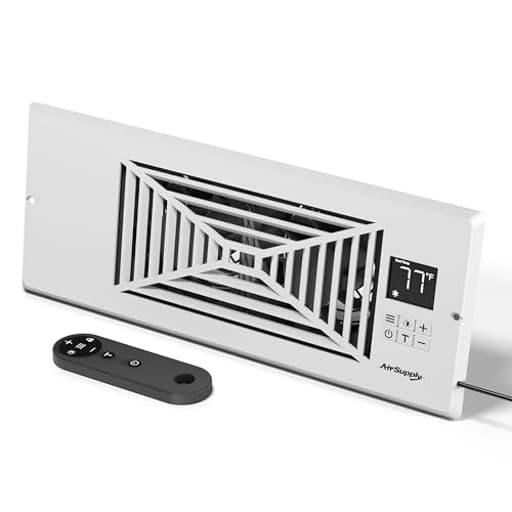
Features
- 【Enhanced Energy Efficiency】Boost the performance of your existing heating and cooling system by improving air circulation for quicker and more even temperature distribution, keeping you comfortable and saving energy.
- 【Intelligent Controls】Benefit from a built-in temperature probe, the fan reacts intelligently. It runs if the airflow’s temp. falls below or rises above the cooling or heating trigger’s setting respectively. A programmable LCD controller with 6 buttons offers intuitive operation. Note: The set temp. only triggers the fan to work and is NOT your room temp. or desired temp.
- 【High-Powered Airflow】A maximum airflow of 180CFM surpasses other brands’ by 50%, providing higher airspeed and further coverage, making it great for larger spaces. Choose from 10 fan speeds or use the TURBO function for the highest speed with just one press.
- 【Versatile Four-Way Vent Grille】Designed to fit 4’’x12’’ registers on either the wall or the floor. The 4-way vent grille is uniquely crafted at a 45° angle to facilitate airflow in all four directions, optimizing circulation in any room.
- 【Where To Use】This booster fan is specifically engineered for aging central air systems, situations where registers are distant from the main HVAC unit, or cases where multiple rooms rely on the same HVAC unit.
Specifications
| Color | White |
| Size | 4'' x 12'' |
Related Tools
An in-register booster fan that fits standard 4" x 12" wall or floor registers and increases airflow up to 180 CFM to improve distribution from central HVAC systems. It includes a 4-way 45°-angled grille, 10 selectable fan speeds plus a turbo mode, and intelligent controls with a programmable LCD, built-in temperature probe for thermostat-based activation, and a remote.
TURBRO Register Booster Fan, Fits 4” x 12” Register Holes, Enhances HVAC Airflow, 4-way Vent Grille, 10-speed Fan, Intelligent LCD Controller, Thermal Probe, Thermostat Control, Remote Control, White Review
Why I tried a register booster
In my two-story home, one corner room stubbornly lags behind the thermostat—cool in summer, chilly in winter. I’ve balanced dampers, added weatherstripping, and even checked for duct leaks. Helpful, but not enough. I installed the Turbro register booster in the room’s 4x12 floor register to see if active assistance at the vent could make a measurable difference.
Short version: it does move a lot of air for its size, and the directional grille is genuinely useful. The onboard thermostat logic is helpful once you understand how it works, but it also reveals a few quirks you’ll want to plan around.
Installation and first impressions
Setup is straightforward. Pull the old register, drop this into the 4x12 opening, and plug it in. There’s no duct cutting or wiring—just make sure you have an outlet nearby for the power cord. The white finish is clean and neutral, and the profile is a bit taller than a standard register but not obtrusive. The 4-way grille is angled at 45°, which sounds minor until you put it near a wall. Instead of blowing straight up (and into a wall), it pushes air outward in four directions. In my floor vent that sits tight to a baseboard, that design choice really helps project air into the room.
Build quality feels solid for a powered register: the grille sits flush, the display is easy to read, and the buttons give positive feedback. There’s also a simple remote, which I appreciated when I had furniture over the floor vent and didn’t want to kneel down to change speeds.
Controls and how the “thermostat” actually works
The Turbro has two primary modes—Heat and Cool—plus manual speed control across 10 steps and a Turbo button.
- Heat mode: the fan turns on when the air at the vent gets warmer than your set trigger.
- Cool mode: the fan turns on when the air gets cooler than your set trigger.
That set number is not a target room temperature. It’s a threshold for the air coming through the register, measured by the unit’s built-in temperature probe. Think of it as a smart on/off gate for the fan. If you expect the booster to manage your room to a specific temperature, you’ll be disappointed. But if your goal is to help distribute conditioned air when your HVAC is actually pushing it, this logic makes sense.
The LCD and six-button layout are intuitive: mode toggle, up/down for the trigger value, a speed selector, power, and Turbo. I set Heat mode to a sensible threshold for my winter supply air and let it run.
Airflow and real-world improvement
Turbro rates the max airflow at 180 CFM. I didn’t bench-test it, but subjectively it’s punchy—enough that it extends the throw of the vent several feet farther than the passive register ever did. On a cool January morning, running the booster at mid-speed, the problem room climbed about 3–5°F faster during a call for heat. In summer, on a mild test day, I saw a similar improvement getting cool air across the room rather than pooling near the vent.
The 10-speed range is genuinely useful. For daily use, I landed around speed 4–6 for a balance of airflow and noise. Turbo is there if you want a quick blast to jump-start circulation, but it’s louder and not something I’d leave on while working or watching TV.
Noise profile
On low speeds (1–3), the booster is very quiet—background whoosh you’ll forget quickly. Midrange (4–6) is audible but acceptable for common areas; I’d hesitate to run above 5 in a bedroom if you’re a light sleeper. At the high end (7–10), expect pronounced airflow noise; Turbo is louder still and best used momentarily. I didn’t hear mechanical rattles or whining—just airflow noise scaling with speed.
If your ducts are especially restrictive, any booster will be louder because it’s working harder to pull and push air through the bottleneck. That’s not unique to this unit, but it’s worth noting.
Smart behavior: helpful but a bit abrupt
Because the trigger is based on vent temperature rather than room temperature, the fan cycles only when your HVAC is producing sufficiently hot or cold air. That’s exactly what you want. However, when the vent temperature floats around your trigger point (say, at the beginning or end of a furnace cycle), the fan can click on and off more frequently than feels ideal. There’s no user-adjustable differential (hysteresis), so the cycling is a function of how tightly the vent temperature and trigger hover around each other.
A couple of practical ways I tamed this:
- Nudge the trigger a couple degrees away from the typical vent temperature so you’re not riding the edge.
- Use manual speed control during shoulder seasons when supply temps are modest.
Once I did that, the behavior felt more predictable.
Reliability and quirks
Over several weeks, I ran into one odd episode where the display flickered and the mode flipped from Heat to Cool after a brief power interruption. A full power cycle returned everything to normal, and it hasn’t resurfaced. I wouldn’t call it a dealbreaker, but it’s something I’ll keep an eye on. If your outlets are prone to dips or surges, a small surge protector is a cheap safeguard for any powered register fan.
The remote has been reliable across a typical living-room distance. The LCD is readable from a few feet away, though I primarily relied on the remote once everything was dialed in.
Where this shines—and where it doesn’t
This booster works best in rooms at the end of long duct runs, older HVAC systems where static pressure and balance aren’t perfect, or spaces where multiple rooms share one trunk and you can’t get a tech in immediately. It’s also handy for floor registers near walls—the angled grille helps get air into the room rather than up the wall or under furniture.
There are limits. A booster can’t fix a crushed duct, a closed damper, or an undersized trunk. If barely any air is reaching the register to begin with, amplifying it won’t be transformative. Think of this as a nudge that can meaningfully improve distribution, not a substitute for proper duct design or system tuning.
Also, plan the installation with an outlet in mind. Floor cords in walkways can be a tripping risk; route the cable cleanly along a baseboard if possible.
Pros
- Noticeable airflow increase with a wide, useful 10-speed range plus Turbo
- 4-way, 45° grille meaningfully improves throw in wall-adjacent floor vents
- Intelligent trigger-based operation that runs with actual hot/cold supply air
- Simple, readable controls and a handy remote
- Fits standard 4x12 wall or floor registers without duct modifications
Cons
- Fan can short-cycle around the trigger point; no adjustable hysteresis
- High speeds and Turbo are too loud for quiet rooms
- Occasional control quirk after power blips requires a reset
- Requires a nearby outlet and tidy cable routing
- Trigger is not a room thermostat; expectations need to match the design
Final thoughts
After living with the Turbro register booster, I’m convinced that a powered register can be a practical, low-effort way to help an imbalanced room keep pace with the rest of the house. The combination of meaningful airflow, a genuinely helpful directional grille, and straightforward controls hits the right notes. The “smart” behavior is effective once you understand that the set temperature is a vent trigger, not a room target. Noise is well managed in the low-to-mid range, and Turbo is there when you need a quick push.
I’d recommend this booster to homeowners with one or two lagging rooms who want a non-invasive, DIY-friendly assist. It’s not a silver bullet for poor duct design, and it’s not the quietest option at full tilt, but used wisely—mid speeds, sensible triggers—it can close the comfort gap by several degrees without touching the furnace or cutting into ducts. If you’re a very light sleeper or you need tight, thermostat-like control at the room level, you may want to rely on manual speeds or consider a zoning solution. For most situations like mine, though, this strikes a solid balance of performance and practicality.
Project Ideas
Business
Retrofit Installation Service for Older Homes
Offer a premium retrofit service targeting older homes with weak register airflow. Service includes home airflow assessment, supply and installation of the 4"x12" booster fans in key rooms (bedrooms, living room, offices), thermostat integration, and a demonstration of controls. Package upsells: decorative grille options, multi-room installation discounts, and seasonal tune-ups.
Property Manager / Landlord Bulk Program
Create a bulk-sell and maintenance plan for landlords, multi-family buildings, and short-term rental operators. Offer volume pricing, scheduled replacements, and technician visits to optimize tenant comfort and reduce HVAC complaints. Provide simple training materials for on-site staff and a subscription option for monitoring and rapid replacements.
White-Label Decorative Grille Bundles
Design a line of custom decorative faceplates (wood, brass, painted metal) that clip onto the standard fan grille and sell bundle kits to interior designers and builders. Market as retrofit aesthetic upgrades that preserve the intelligent fan core. Offer online configurator, seasonal designs, and partnerships with boutique hardware shops.
HVAC Contractor Partnership & Lead Gen
Partner with local HVAC companies to offer the booster fan as a value-add upgrade during service calls. Provide contractors with demo units, training, and co-branded marketing materials. Track performance with before/after case studies (reduced complaints, faster room temps) to help contractors upsell and win maintenance contracts.
Content & Demo Studio — Performance Before/After
Build a content-driven small business showcasing measurable improvements: record thermal-camera and airflow demos comparing rooms with and without the booster fan, produce short how-to install videos, and run targeted ads showing energy savings and comfort gains. Monetize with affiliate sales, product bundles (grilles + fan + thermostat), and workshops teaching DIY installations for homeowners.
Creative
Register-to-Planter Vent Cover
Turn the 4"x12" booster fan into a living vent planter: mount the fan behind a shallow reclaimed-wood decorative grille, place a waterproof tray and shallow succulent/air-plant bed on top, and use the low fan speeds to circulate air through the planter. The fan keeps the microclimate stable for humidity-loving plants and masks HVAC noise with gentle airflow. Use the programmable temperature probe to only run the fan when the room hits predefined temps, preserving plant comfort.
Hidden Pet Cooling/Heating Nook
Create a recessed pet bed niche with integrated register booster fan to give pets a warm or cool microclimate. Install the fan in a low wall register behind a cushioned alcove; set the LCD controller to run at comfortable temperatures or on a low constant speed for airflow. The 4-way grille distributes air evenly so the sleeping spot stays cozy in winter and cool in summer without redirecting house airflow.
Quiet Server/Closet Ventilation
Repurpose the booster fan to ventilate small electronics closets, sewing rooms, or media cabinets where overheating is a risk. Mount into an interior register or cut-in panel, use the temperature probe to trigger the fan when equipment warms up, and run at low speeds for silent, continuous convection. The 10-speed range and turbo mode let you balance noise versus cooling for sensitive gear.
Decorative Diffuser & Aromatherapy Panel
Convert the grille into an attractive ceiling or wall diffuser: attach a slim essential-oil/wick tray behind the grille so the fan’s airflow disperses scent throughout a room. Use programmable schedules or thermostat triggers so the fan only runs during occupied hours (or with motion/remote). Finish with a powder-coated decorative faceplate for boutique home fragrance installations.
Shoe & Gear Drying Slot
Build a narrow drying cabinet or bench with a register slot fitted with the booster fan. Place shoes, gloves, or wet gear above the vent; set the unit on a low to medium speed to gently circulate warm air and accelerate drying. The temperature probe ensures the fan only runs when the cabinet warms up (preventing condensation), and turbo mode can be used for quick drying sessions.