Features
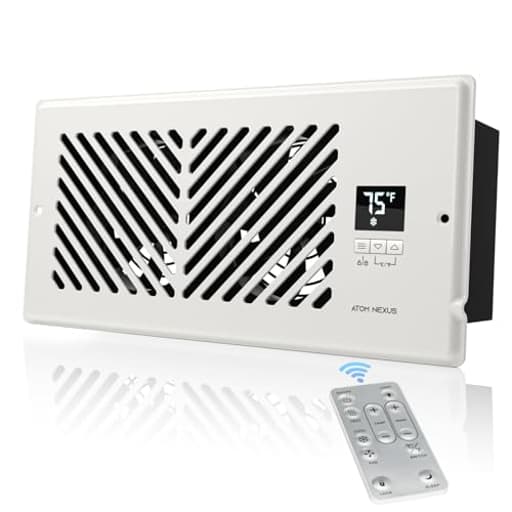
- Optimize Airflow: Balance room temperatures effortlessly. ATOM NEXUS register fan complements the HVAC system by redistributing warm and cold air, achieving a harmonized temperature throughout your space. Enjoy heightened comfort, energy savings, and reduced costs. One fan's airflow is 1.8m³/min. For large rooms, multiple fans are recommended for effective airflow.
- Intelligent Temperature Control: Equipped with high-precision temp probe sensors, the smart register booster fan automatically monitors temperature and triggers the fan to operate according to your set cooling or heating temperatures. With 10 adjustable speeds and a remote control effective within a 5-meter range, enjoy convenient adjustments from anywhere in the room.
- Tranquility and Efficiency: Featuring ultra-quiet hydro-mechanical stator blades and a PWM motor, these units operate at a whisper-quiet level below 18 dBA, ensuring tranquil environments and energy savings without sacrificing performance. The motor's dual ball bearings enhance performance and offer a remarkable 67,000-hour lifespan.
- Premium Design: Featuring a sturdy aluminum frame with CNC-machined detailing and a sleek matte finish, this air register booster fan boasts a modern and stylish design that seamlessly complements any decor. Easy installation on walls or floors (not recommended for ceiling mounting). The air boosting fan uses a plug-in power cord for use, not battery-powered.
- Fits 4'' x 10'' Register: ATOM NEXUS register booster fan perfectly fits 4"×10" register holes (standard size). Please measure your register hole to ensure it matches the product size before buying. Compatible register holes range in width of 3.90~4.25 inches and length of 9.73~10.25 inches. Package also includes a vent cover to block the outlet when the fan is not in use, which prevents dust.
Specifications
| Color | White |
| Size | 4 x 10 inch |
| Unit Count | 1 |
Related Tools
This plug-in register booster fan fits standard 4×10 inch HVAC registers (compatible with openings about 3.90–4.25 in by 9.73–10.25 in) and redistributes heated or cooled air to reduce temperature differences between rooms. It includes a thermostat probe for automatic temperature-triggered operation, 10-speed PWM motor (airflow 1.8 m³/min), remote control, ultra-quiet operation below 18 dBA, and a vent cover; intended for wall or floor installation (not ceiling).
ATOM NEXUS Quiet Register Booster Fan Fits 4”x10” Register Holes, Smart Vent Booster Fan with Thermostat & Remote Control, 10-Speed Control Heating Cooling AC Vent Review
Why I tried a register booster
Uneven temperatures are the reality of many homes, especially on upper floors or at the end of long duct runs. In my case, one bedroom ran a few degrees warmer in summer and cooler in winter than the rest of the house, despite clean filters and dampers tweaked for balance. Rather than tinkering further with the main system, I installed the Atom Nexus booster in a standard 4×10 floor register to see whether actively pulling conditioned air from the supply would help.
Installation: quick, but measure twice
The Atom Nexus booster is designed to drop into a standard 4×10 opening, but register cutouts vary more than you’d expect. Before ordering, I removed the existing grille and measured the opening—important detail, because the fit tolerance here is fairly tight (roughly 3.90–4.25 inches by 9.73–10.25 inches). In my case, it slid in without shaving a flange or re-drilling holes. If your cutout is on the small side of “standard,” double-check; this is one of those products that either fits cleanly or doesn’t fit at all.
Mounting is straightforward. It’s meant for floor or wall registers, not ceilings, and it’s powered by a plug-in cord (no battery). I routed the cable along the baseboard and secured it with low-profile clips. If you care about aesthetics, plan your cord path; making it invisible takes a little thought. The unit’s aluminum frame feels solid and the matte finish looks more modern than a stamped steel grille. A nice touch: a vent cover that snaps on when the fan isn’t in use to keep dust out.
The thermostat probe is built in. For floor installations, that sensor placement reads room-level air reasonably accurately, provided it’s not in direct sunlight. For wall installs, avoid mounting it near heat sources; the automation depends on getting an honest read of the room.
Controls and daily use
Controls are split between onboard buttons and the included remote. You get ten fan speeds, a cooling mode, a heating mode, and an auto mode that engages the fan based on your chosen temperature thresholds. Once set, it does not need babysitting, which is the whole point.
Two small but important setup notes:
- If you leave both heating and cooling automation enabled, the fan can run more than you expect. I disabled the out-of-season mode (cool only in summer, heat only in winter) and the behavior made immediate sense.
- The display stays on. I like having a quick readout of speed and temperature at a glance. If you’re using this in a bedroom and are sensitive to even a small glow, keep that in mind.
The remote worked reliably within a living-room distance. In one room, my TV remote occasionally toggled the fan—classic IR cross-talk. The fix was simple: I repositioned the booster slightly out of direct line-of-sight with the TV and, if needed, kept the booster in auto mode and stashed the remote. After that, no accidental commands.
Performance: real improvement, within realistic limits
What matters most is whether the booster meaningfully changes the room’s temperature. In my 12×12 bedroom at the end of a supply run, the Atom Nexus booster reduced the temperature delta versus the main floor by 2–3°F during hot afternoons. That’s enough to turn a stuffy room into a comfortable one without cranking the central thermostat. Overnight, when the main system isn’t pushing as much, I let the booster run in auto at mid-speed; the room stayed even with the rest of the house.
I also tested it in winter. On the same register, it sped up warm-up time for morning heat cycles and kept the room more stable between cycles. If you have a chronically weak supply, actively drawing air from that branch matters more than you’d think.
This isn’t magic, though. A booster can only move the air that’s available. In smaller bedrooms and offices with standard-length duct runs, one unit at moderate speed does the job. In larger spaces, or for rooms with multiple registers, two units work better—both for airflow and for noise distribution, since you can run each at a lower, quieter setting.
If your duct design is fundamentally constrained (long runs, sharp turns, undersized return air on the floor), a booster will help but won’t solve extreme imbalances by itself. Think of it as the pragmatic middle step between doing nothing and hiring out a duct redesign.
Noise and comfort
The manufacturer cites sub-18 dBA operation, which aligns with low-speed behavior. In real use:
- Speeds 1–3: effectively inaudible in a quiet room. Great for sleep.
- Speeds 4–6: a soft fan hum that fades into background noise. Acceptable for offices and living rooms.
- Speeds 7–10: clearly audible airflow. Not loud by household fan standards, but I wouldn’t sleep next to it at these speeds.
The good news is you rarely need the top end once the room reaches equilibrium. I typically use 5 during the day and drop to 2–3 at night. Compared with running a desk fan, the tonal quality is less intrusive because the airflow is directed into the duct rather than the room.
Build quality and longevity
The Atom Nexus booster feels well-built. The aluminum chassis doesn’t flex, the grille tolerances are tidy, and the PWM motor with dual ball bearings inspires confidence. The brand claims a long service life, and while I can’t validate the hours figure yet, continuous daily use over weeks hasn’t produced any rattles, ticks, or bearing whine.
Maintenance is minimal. I vacuum the grille when I do my usual floor cleaning. If your home is dusty or you have pets, add the booster to your filter-change routine; dust on blades reduces efficiency and can increase noise over time.
What I liked
- Simple, effective temperature control. The thermostatic automation means I set it once and stop thinking about it.
- Fine-grained speed steps. Ten levels make it easy to find the sweet spot between airflow and quiet.
- Solid construction and clean look. It blends better than plastic boosters, and the included dust cover is a thoughtful extra.
- Noticeable room balancing. A few degrees is a big deal when you’re trying to keep a space comfortable without freezing the rest of the house.
What could be better
- Remote interference in IR-heavy rooms. It’s workable but worth calling out if your booster faces a TV.
- Power cord management. A battery option would be impractical for continuous use, but the cord will be visible unless you plan.
- High-speed noise. Air is moving; you’ll hear it. If you need absolute silence, plan to run at low speeds or use two units at lower settings.
- No ceiling option. That’s a limitation of its design, but it’s relevant if your only registers are overhead.
Tips for best results
- Measure the opening with the old register removed; don’t rely on the faceplate size.
- Start with auto mode and set only the in-season mode (cool or heat) to avoid unnecessary runtime.
- If you have multiple registers in one room, consider boosting them all at lower speeds rather than one at max.
- Keep the ductwork clean and the main system filter fresh; boosters can’t compensate for clogged airflow.
- If the remote conflicts with other devices, angle the booster slightly or place it out of direct IR line-of-sight.
The bottom line
The Atom Nexus booster does exactly what a register booster should: it increases usable airflow at the room level and flattens temperature differences without fuss. It won’t fix an HVAC system that’s fundamentally undersized or poorly designed, and it’s not meant to turn a marginal room into an icebox in extreme weather. But for the common case—rooms that linger a couple of degrees off target—it’s a practical, tidy solution that requires no duct surgery and almost no learning curve.
I recommend it for anyone with standard 4×10 registers who wants a targeted, cost-conscious way to balance temperatures. It’s well built, easy to live with, and, at reasonable speeds, quiet enough for bedrooms and home offices. If you’re expecting miracles in a severely under-vented space or you can’t accommodate the power cord, look elsewhere. Otherwise, this is a sensible upgrade that makes everyday comfort easier to achieve.
Project Ideas
Business
Targeted room-balancing service
Offer a home service that diagnoses uneven heating/cooling and installs 4×10 register booster fans in problem rooms. Package includes airflow assessment, fan placement, thermostat calibration and a follow-up tune-up—sell per-room installs and highlight energy savings, faster comfort and the fans' quiet operation as key selling points.
Airbnb / short-term rental optimization package
Market a retrofit package to short-term rental hosts to eliminate hot/cold rooms and reduce guest complaints. Install unobtrusive booster fans in strategic registers, provide simple remote/thermostat training, and offer a maintenance subscription—position it as a low-cost upgrade that increases guest comfort and positive reviews.
Productized grow/germination kit
Create and sell a branded 'Grow Box Climate Kit' that bundles one or more register fans, custom-fit vent covers, mounting instructions and a small wooden or plastic DIY cabinet plan. Target hobby gardeners and urban growers via Etsy/shopify with clear ROI (better germination, quieter operation).
Workshop / restoration dry-time accelerator
Sell or lease booster fans to furniture restorers, woodworkers and small paint shops who need controlled airflow to reduce cure times. Offer bulk discounts, placement consultation (where to add fans for best circulation), and a service plan to clean and replace fans—emphasize the long motor life (67,000 hours) and ultra-quiet operation.
Custom decorative vent & fan bundles
Partner with interior designers to offer bespoke-painted or CNC-detail vent surrounds bundled with the smart register fan for a premium look. Market as an upscale HVAC accessory for remodels—customers get balanced airflow plus a finished, design-forward register rather than a plain grille.
Creative
Closet / boot dryer
Turn a spare closet or mudroom register into a gentle drying chamber for boots, gloves and wet coats. Install the 4×10 booster fan into the closet register, close the vent cover when not in use, and set the thermostat to run only when warm air is available—10-speed control lets you choose a low, safe airflow that speeds drying without blowing dust or overheating items.
Seed-starting microclimate box
Build a small wooden or plastic seed-starting cabinet and mount the register fan to provide controlled, quiet airflow and gentle warmth. Use the high-precision temperature probe and automatic trigger to keep the cabinet in the optimal germination range; the ultra-quiet operation keeps indoor spaces peaceful while improving seedling uniformity.
Low-temp drying cabinet for crafts
Create a drying cabinet for painted, glued or varnished craft pieces by installing the booster fan into a repurposed dresser drawer or cabinet. The PWM motor and 10-speed settings deliver steady, adjustable airflow to reduce drying time, while the thermostat probe prevents overheating delicate finishes.
Kinetic air-sculpture / mobile display
Use the fan as a hidden mover for lightweight mobiles and paper or fabric sculptures in a gallery or home installation. The remote and fine speed control let you choreograph subtle motion; because the fan runs under 18 dBA, it preserves a quiet viewing environment while adding dynamic visual interest.
Pet micro-climate bed
Make a warmed or cooled pet nook by routing tempered air into a raised pet bed or enclosed pet house via a 4×10 register opening. The automatic thermostat keeps the space safe and comfortable, the low noise avoids disturbing animals, and the vent cover closes the outlet when not needed.