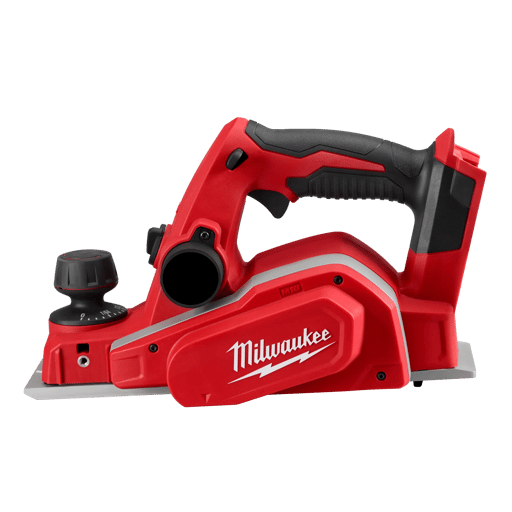
Features
- Powerful motor for efficient material removal
- Depth adjustment dial with 20 locking positions
- Chip ejection switch selectable for left or right exhaust
- Spring-loaded kickstand to protect finished surfaces
- Dual-blade cutting head for a smooth finish
Specifications
| Cutting Width | 3-1/4 in |
| Cutting Head | Dual blade |
| Depth Adjustment | 20 locking positions |
| Chip Ejection | Selectable left or right exhaust |
| Kickstand | Spring-loaded to protect finished surfaces |
Related Tools
Related Articles

Handheld 3-1/4-inch planer for removing material and smoothing wood surfaces. It uses a dual-blade cutting head for a finer finish, provides a depth adjustment dial with 20 locking positions for repeatable cuts, and includes a selectable chip ejection and a spring-loaded kickstand to protect the workpiece.
Milwaukee 3-1/4-inch planer Review
First impressions and setup
I reached for this 3-1/4-inch Milwaukee planer to see if a cordless option could keep up with my shop’s mix of trim fixes and small surface cleanups. Out of the box, the layout is familiar: a depth dial up front with firm detents, a two-knife cutterhead, selectable left/right chip ejection, and a spring-loaded kickstand that drops as soon as you set the tool down. The form factor is compact enough to one-hand onto a board while your other hand steadies the work.
Blade installation is straightforward, and the dual-blade head promises a fine finish on stock that isn’t fussy. The depth adjustment has 20 locking positions, and the clicks are positive—you won’t bump it off setting mid-pass. On paper, it checks a lot of boxes.
Design and features worth calling out
- Dual-blade cutting head: When everything else cooperates, this leaves a notably smooth surface in softwoods and light passes on closed-grain hardwoods.
- Depth dial with 20 locks: The detents are tactile, and repeatability is easy. I could step down in predictable increments without second-guessing the drum.
- Selectable chip ejection: Being able to flip the exhaust left or right helps you keep chips off your line or blow them away from your body in awkward setups.
- Spring-loaded kickstand: Simple and effective. It saves edges and keeps the knives off your work at set-down.
- Overall ergonomics: The front knob is easy to index for pressure control, and the main handle promotes a neutral wrist angle for longer work sessions.
So far, so good. Unfortunately, performance hinges on more than a friendly feature list.
Performance and cut quality
My first passes were on straight-grained pine, dialed to 1/64 in. The surface came off the tool cleaner than I expected for a cordless planer, and the finish quality matched many corded models I’ve used for shallow cuts. The motor didn’t lug at that depth, and I could creep along a door edge and hit my line accurately.
Then I tried to plane a reference board at a zero-depth setting—a trick I use to confirm that the back shoe and blade are coplanar. The tool still removed material, more so on the right side of the cut, and left a faint track. Increasing the depth and making repeat passes exaggerated the slope, turning a square test piece into a very subtle wedge. I pulled the knives, re-seated them carefully, verified they were evenly seated, and tried again. Same behavior.
Thinking I’d drawn a bad sample, I swapped the unit for another. The second exhibited nearly identical tendencies: even at “0,” it wanted to bite, and it favored the right side enough that I had to constantly bias my pressure to compensate. On practical jobs—shaving a door or easing a sticking stile—I could work around it with a careful stance and feather-light depth. But for any surface where flatness across the full 3-1/4-inch width mattered, those tracks and the built-in bevel were nonstarters.
When the cut did stay true (on narrow edges and light skim passes), the two-knife drum produced a respectable finish. Snipe at the beginning and end of a pass was minimal if I kept my weight forward at entry and rolled to the rear shoe on exit. But the geometry issue overshadowed everything else for me.
Power and material range
On softwoods at 1/64 to 1/32 in., the motor holds its own. I could take long passes across studs and trim without it sounding strained. Once I pushed beyond 1/16 in. depth on wider faces, especially on denser stock, the limitations showed. On pressure-treated lumber, long passes at anything more than a whisper-thin cut invited slowdowns and, at times, stalls when chips backed up.
If your workflow is mostly easing doors, knocking down proud joints, or chamfering edges in pine, the planer feels competent. If you’re expecting to hog off material across eight feet of PT or to flatten hardwood faces aggressively, plan for many shallow passes—and be ready to stop and clear chips.
Chip ejection and clogging
Selectable chip ejection is a thoughtful feature. In tight spaces, flicking the switch to keep the exhaust away from your face is welcome. However, the port design seems undersized relative to the chip volume at anything beyond very light cuts. In practice, I saw frequent clogs that started at the exit and worked backward into the drum, especially in stringy stock or when I tried to step up the depth.
Once the port begins to choke, performance degrades quickly: chips have nowhere to go, the drum compresses them, and the cut quality nosedives. Clearing the passage is easy enough with a brush or blast of air, but the interruption adds up if you’re trying to get through longer boards.
Practical tips that helped:
- Keep cuts shallow and steady; avoid heavy “bites.”
- Flip the ejection side to suit the grain and your stance; sometimes one side clears a tad better depending on how chips fling off the knives.
- Avoid damp or very resinous material when possible; both increase the tendency to clog.
- Stop early at the first hint of a sluggish exhaust note and clear the port before forcing the cut.
Accuracy, alignment, and the rear shoe
Planers live or die by how well the blade and rear shoe align. On both samples I tested, zero wasn’t truly zero, and the right side cut deeper. That manifests as:
- A subtle but persistent bevel across the width.
- A track or groove that refuses to disappear with additional passes.
- The need to “cheat” the tool—biasing pressure or tilting slightly—to get a flat result.
I inspected for the usual culprits: improperly seated blades, debris under the knives, a front shoe not returning to height. Everything checked out, and the issue remained. There isn’t a user-facing way to adjust the rear shoe’s relationship to the cutting circle on this design, so if your unit arrives out of plane, you’re left with workarounds rather than a true fix. That’s a tough pill to swallow for a precision tool.
Where it shines
- Light trimming and door work where you can reference off a narrow edge.
- Quick chamfers and easing operations at shallow depth.
- Situations where cordless convenience trumps raw removal rate.
- Jobs that benefit from a fine finish straight off the tool with minimal sanding afterward.
Where it struggles
- Flattening or fairing wider faces that demand dead-flat results.
- Long passes in pressure-treated stock or dense hardwood at moderate-to-deep settings.
- Maintaining chip flow during sustained cuts; clogs are common if you push it.
Ergonomics and build
The controls are intuitive, and the detented dial makes repeat cuts simple. The kickstand does exactly what it should, and I appreciate not having to think about where to set the tool down mid-job. In-hand balance is good enough for one-handed edge work, and the general fit and finish meet expectations. Unfortunately, those positives can’t compensate for the alignment and chip management issues I encountered.
The bottom line
There’s a capable cordless planer hiding in here: the dual-blade head leaves a smooth surface, the depth dial is precise, and the convenience features are thoughtful. But a planer’s core promise is a flat, controllable cut, and the two units I tested both missed that mark. Add in frequent chip ejection clogs when you try to move beyond whisper-thin passes, and the experience becomes more about managing quirks than getting work done.
Recommendation: I don’t recommend this planer for users who need reliable flatness across a full 3-1/4-inch width or who frequently plane pressure-treated or dense hardwood stock. If you happen to get a sample that’s perfectly in plane, and your workload is mostly light trimming in softwoods, the tool’s finish quality and convenience could serve you well. However, given my back-to-back alignment issues and the persistent chip ejection clogs under moderate cuts, I can’t endorse it as a dependable, accuracy-first planer. For most woodworkers and carpenters, that uncertainty is reason enough to look elsewhere.
Project Ideas
Business
Mobile trim & fitting service
Offer on-site trimming, undercutting, and scribing for contractors and homeowners. Use the planer to fit doors, trim, thresholds, and stair nosings quickly without returning to the shop. Pricing can be hourly or per-door/trim-piece; promote same-day fixes and reduced turnaround for renovations. Selectable chip ejection keeps the worksite clean and the kickstand protects finished work during repeat adjustments.
Pre-planed reclaimed wood supply
Source reclaimed boards and offer them sold-by-foot as pre-flattened, consistently-thicknessed stock for makers. Use the planer to produce board sets matched for thickness and finish; charge by board-foot with premium for matched grain sets. The dual-blade finish reduces prep time for customers, making your product attractive to small furniture shops and Etsy craftsmen.
Small-batch trim/molding production
Produce limited runs of custom trim and simple molding profiles for local builders and designers. Use the planer for the initial profile shaping and finish with a router or sanding. Sell standard lengths and custom orders; offer finishing options (stain/paint priming). Keep inventory of popular profiles and offer rush production for renovation projects.
Hands-on planer workshops
Run half-day classes teaching safe planer use and small projects (floating shelf, simple frame, shiplap panel). Charge per student and include materials and tool rental. Workshops build trust, convert students to customers for planing services or pre-made items, and create opportunities to sell replacement blades, maintenance, and upgrades.
Deck and stairboard resurfacing service
Offer seasonal maintenance: plane away splinters, uneven board faces, and old surface coatings from deck and stair boards. Use the planer to restore usable surface quickly, then follow with sanding and sealing. Sell seasonal contracts (spring and fall) to homeowners associations and property managers; advertise improved safety and extended board life as selling points.
Creative
Chamfered picture frames
Use the 3-1/4" planer to create consistent chamfers on frame stock. Set the depth dial to a shallow setting and make repeated passes along each rail to remove small amounts until you get the desired bevel. The dual-blade head gives a smooth finish that minimizes sanding; use the spring-loaded kickstand to protect completed pieces between passes. Make matched sets in different widths (e.g., 3/4" and 1") for a small line of handcrafted frames.
Reclaimed-wood coffee table top
Plane pallet or reclaimed boards flat and to consistent thickness before edge-joining. Use the 20-position depth adjustment for controlled stock removal and the dual blades for a clean surface ready for glue-up. Flip the chip ejection depending on board orientation to keep the work area clear. This yields a rustic but smooth tabletop that highlights character wood without heavy sanding.
Shiplap/tongue-and-groove accent panels
Create shiplap or shallow tongue-and-groove profiles by removing small amounts off the face and edges in staged passes. The precise depth dial makes repeatable rabbets and bevels possible; clamp a simple jig to guide the planer for consistent profile spacing. Finished panels can be used for accent walls, cabinet backs, or headboards.
On-site door and threshold fitting
Use the planer to undercut doors, trim thresholds, or thin a door edge for perfect fit. The narrow 3-1/4" cutting width is ideal for accurate localized trimming; the kickstand protects finished doors when you set them down. This is a great small-project skill — trim, test, and repeat with the depth dial for tiny, controlled removals.
Custom beaded molding and trim
Fabricate simple moldings by removing progressive amounts of material to produce beads, chamfers, and small coves. Work in multiple light passes using the locking depth positions to replicate the same profile across lengths. The dual-blade head reduces tear-out for cleaner decorative edges; finish lightly with a scraper or sandpaper for a boutique trim line.