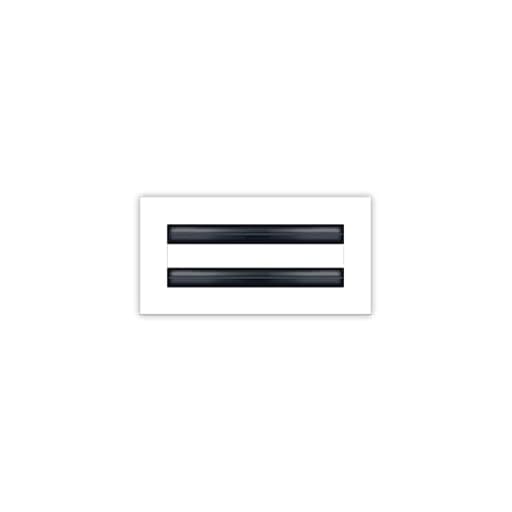
Features
- Commercial grade solid aluminum with modern architectural design for ceilings, walls, and floors. This vent cover was designed to be decorative and not structural. You can use this as a floor vent cover, but it is not designed to support weight, adding any type of weight is not recommended. This model can be used as a supply vent cover and return vent cover - This is a non-filter model
- Cfm: 142 ft3/min - effective velocity: 9.8 ft/s; neck: 7 13/16" x 3 7/8" - face: 9 3/4" x 5 3/4" (The neck is the section that goes into the vent hole while the face is what will actually cover)
- Designed to elevate any space, our modern AC vent covers are perfect for bathrooms, kitchens, living rooms, offices, and commercial settings. Whether you're remodeling or upgrading, they add sleek, architectural value to walls, ceilings, and floors.
- *This is a design and utility patent pending product* We make all sizes from 6x4 to 30x24 standard sized modern ac vent covers for the modern day home
Specifications
| Color | White |
| Size | Neck: 7 13/16" x 3 7/8" - Face 9 3/4" x 5 3/4" |
Related Tools
Solid aluminum decorative AC vent cover for ceilings, walls, and floors, suitable for use as a supply or return grille (non-filter model). Face measures 9 3/4" x 5 3/4" with a neck of 7 13/16" x 3 7/8", rated at 142 ft3/min with an effective velocity of 9.8 ft/s; not designed to support weight.
BUILDMART - 8x4 White Modern AC Vent Cover - Decorative Air Vent - Standard Linear Slot Diffuser - Register Grille for Ceiling, Walls & Floors - Texas Buildmart Review
A small piece of hardware can change how a room feels. Swapping out a tired stamped register for a clean linear slot can instantly modernize a space, and that’s exactly what I set out to test with Buildmart’s 8x4, two‑slot vent cover. I installed it in a bathroom ceiling and a small bedroom wall to see how it handled both supply and return duty, and whether the aesthetics came with any compromises in airflow, noise, or day‑to‑day usability.
Design and build quality
This vent cover lands squarely in the “architectural” camp—straight lines, tight edges, and a minimalist two‑slot face. It’s made from solid aluminum, which immediately feels more substantial than the thin steel stampings or plastic grilles common in older homes. The finish on mine is a bright white with a slight gloss; it reads clean rather than chalky, and it avoids the plasticky look you get from budget options. The housing and internal vanes are rigid, with no rattle when you tap or flex them.
At the face, the cover measures 9 3/4 by 5 3/4 inches; the neck (the portion that slides into the duct opening) is 7 13/16 by 3 7/8 inches. That’s standard for an “8x4” rough opening, and both of my test locations accepted it without frame modification. I appreciate Buildmart publishing airflow data: it’s rated at 142 cubic feet per minute with an effective velocity of 9.8 ft/s. In practice, that specification tracks with how it behaves in a small room—you get a defined, linear throw without the blast you sometimes get from multi‑louver faceplates.
One important caveat: this is a decorative cover, not a structural floor grille. You can use it on the floor in low‑traffic areas, but it is not designed to support weight. For my installs, ceiling and wall placements made the most sense.
Installation experience
The face uses “hidden” screws that mount from the inside at an angle, so you don’t see exposed screw heads on the front. The tradeoff is that installation is a little more fiddly than a standard grille. Here’s what worked for me:
- Measure the neck, not just the face. The 7 13/16 x 3 7/8 neck slipped into both openings, but older homes may have unevenly cut drywall. Be prepared to square the edge or shave high spots.
- Use a drill/driver with a long bit extension. The angled screw path requires reaching into the slot; a standard short bit will fight you.
- Pre‑drill and use anchors where necessary. The hidden screw pattern can land on drywall rather than wood framing. If you’re not catching a stud, anchor the hole to avoid a weak grab.
- Protect the finish while you work. Low‑tack tape on the face made it easier to handle without leaving smudges or scuffs.
Once mounted, the frame sits tight and flush. The concealed hardware does its job—nothing breaks the clean lines.
Airflow and adjustability
This model can be used as either a supply or return cover; it’s a non‑filter design, so don’t expect a slot for a return filter. On supply, the internal vanes let me deflect air up or down; there’s no left‑right swing, which is typical for linear slot diffusers. In the bedroom, pitching the vanes upward minimized drafts at seated height while still moving air across the ceiling. In the bathroom, a slight downward tilt kept conditioned air from short‑cycling back into the return.
Noise performance was solid in both placements. With the system at normal speed, I heard a low whoosh, but no whistle. Even at higher blower speeds, there was no buzz or rattle—likely a credit to the aluminum construction and tight tolerances. If you’re chasing absolute silence, aim the vanes so the airstream doesn’t hit the slot edge directly, and avoid fully closing them; like most registers, max restriction can raise velocity and noise.
If you plan to use this as a return, simply open the vanes fully and let it breathe. Again, there’s no filter provision—if your system relies on a return grille filter at that location, choose a different model or relocate filtration to the air handler.
Finish, paintability, and maintenance
Out of the box, the white finish is clean and consistent. It’s a bit glossier than a factory satin trim paint, which looks great against white ceilings and many wall colors. In a dark bathroom where I wanted the grille to visually disappear, I repainted mine to match. Prep matters: a light scuff sand, a coat of adhesion primer, and then two light coats of finish produced a durable result. Skipping the primer step on gloss can lead to poor adhesion, so don’t rush it.
Cleaning is straightforward. Dust tends to settle on the edges of the slots; a microfiber cloth or a quick pass with a vacuum brush attachment keeps it tidy. The vanes are accessible enough to wipe down without removing the cover.
Real‑world fit and performance
- Bathroom ceiling supply: Plenty of throw for a roughly 60–80 CFM branch. With the vanes tilted slightly, the airflow skimmed the ceiling and distributed evenly. No condensation issues, and the aluminum construction gives me confidence in a humid environment.
- Bedroom wall return: Open vanes, zero restriction, and a quiet pull. Aesthetically, the linear slots feel intentional—a small, modern design note rather than an afterthought.
Across both installs, what stood out was the upgrade in visual presence without sacrificing function. Many designer grilles look great but choke off airflow; this one held up well to the basic expectations of HVAC hardware.
What I liked
- Solid aluminum build: Rigid, no flex, and no buzz at typical system speeds.
- Clean, modern look: The linear two‑slot face transforms a room’s trim details in a good way.
- Hidden fasteners: Once installed, the face is uninterrupted and crisp.
- Versatility: Works on walls, ceilings, and low‑traffic floors; supply or return use.
- Published airflow data: The 142 CFM rating with a stated effective velocity gives a ballpark for sizing.
What could be better
- Installation ergonomics: The angled, concealed screws look great but demand a long bit and patience. Expect a little extra time per vent, especially in uneven openings.
- No lateral deflection: Up/down control is fine, but you can’t swing left/right. If you need to bend air around a corner, you’ll need a different diffuser.
- Non‑filter design: That’s by design here, but it’s worth noting for anyone replacing a return grille that currently holds a filter.
- Not for foot traffic: Floor use is okay in a pinch, but do not expect it to bear weight. If you need a floor‑rated grille, choose one designed for loads.
Sizing and compatibility tips
If you’re planning a whole‑home refresh, measure duct openings, not the old faceplate. “8x4” refers to the opening—this cover’s neck at 7 13/16 x 3 7/8 fits a standard 8x4, and the face at 9 3/4 x 5 3/4 covers the hole with a comfortable margin. Confirm depth clearance, too; the neck depth on mine was compatible with shallow wall cavities, but older plaster walls with lath or oversized boot flanges can crowd the fit.
For mixed installations (ceilings and walls), consider your finish scheme. The white is neutral and clean; if you want it to disappear against dark paint, it takes refinishing well with proper prep.
Bottom line
The Buildmart vent cover is a thoughtfully executed upgrade: commercial‑grade aluminum, a modern two‑slot aesthetic, and airflow performance that doesn’t sabotage your HVAC system. It asks for a bit more effort during installation and it won’t solve every airflow challenge, but once it’s in, it looks and feels like a component from a higher tier of architectural hardware.
Recommendation: I recommend this vent cover to anyone looking to modernize the look of their vents without compromising day‑to‑day function. It’s especially well suited to ceilings and walls in living spaces, bathrooms, and offices where clean lines matter. Skip it if you need a return grille with an integrated filter, lateral airflow control, or a floor unit that can handle foot traffic. For most residential upgrades, though, it’s a smart, durable choice that elevates the room with minimal downside.
Project Ideas
Business
Architectural Vent Upgrade Service
Offer a targeted upgrade package for remodelers and homeowners: replace stock HVAC registers with modern aluminum designs in matched sizes (6x4 to 30x24). Package includes selection of finishes, removal/installation, and optional light cleaning of duct openings. Market to interior designers, property managers, and renovation contractors as an easy aesthetic upsell.
Custom Finish & Color Line
Differentiate by offering custom powder-coating, textured finishes, or two-tone options (e.g., matte white face with contrasting neck). Sell direct-to-consumer via an e-commerce store and provide a small swatch service. Target boutique hotels, offices, and high-end residential clients who want cohesive architectural details.
DIY Decorative Kits for Makers
Create and sell kits that turn a vent cover into a finished home accessory (wall light kit, organizer kit, planter kit). Kits include mounting hardware, backing panel, LED strips or hooks, and step-by-step instructions. Market through craft marketplaces and social platforms to DIYers and interior-decor influencers.
B-Grade Upcycle Product Line
Purchase discount or slightly imperfect vent covers and repurpose them into homegoods—trays, jewelry hangers, tabletop risers, or small shelf fronts. Because the product is already decorative and made of aluminum, minor cosmetic defects can become design features. Sell through Etsy, makers markets, or wholesale to boutique home stores.
Creative
Modern Vent Grid Wall Art
Create a striking geometric wall installation by mounting multiple 9 3/4" x 5 3/4" vent covers in a grid or staggered pattern. Paint some covers matte black or metallic, backlight each opening with thin LED tape, and mount on a slim plywood panel for a low-profile, architectural art piece that doubles as ambient lighting. Note: secure with screws into the wall — covers are decorative only and not load-bearing.
Pendant Lamp / Light Diffuser
Turn a single aluminum vent cover into a modern pendant shade: attach it as an outer diffuser around an LED puck or low-heat LED strip (LEDs recommended because the aluminum conducts heat). Use a small mounting ring and an insulated socket kit so the vent cover doesn't touch live parts. The slotted face creates attractive linear light patterns for kitchens or over an island.
Mail & Key Organizer
Make a wall-mounted entry organizer by fixing a vent cover onto a wooden board and adding a shallow shelf or pocket behind it to catch mail. Use the slats to hang S-hooks for keys, sunglasses, and lightweight accessories. The modern aluminum face keeps a clean, architectural look while hiding clutter behind it.
Vertical Succulent Panel
Use the vent cover as a decorative front for a small vertical planter: attach a shallow box behind the cover, line with a water-resistant membrane, add a thin soil tray and drought-tolerant succulents. The slots offer airflow and a modern frame for greenery. Keep plant weight minimal and water carefully to avoid leaks—covers are not designed to support heavy loads.