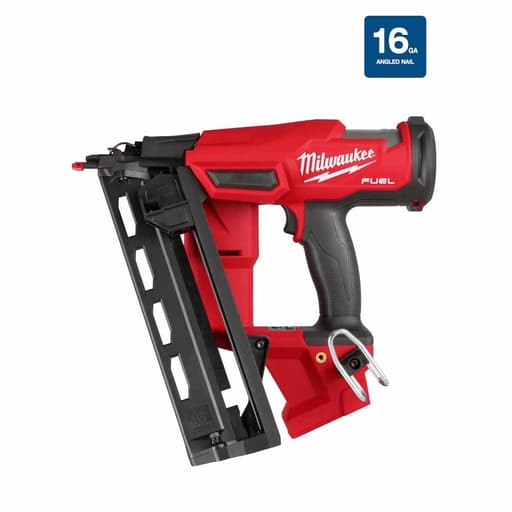
Features
- Consistent and clean nail holes
- Compact design for tight spaces
- No delay between trigger pull and nail fire
- Tool-free depth adjustment
- Tool-free jam clearing latch
- Sequential and contact actuation firing modes
- LED work light
- Reversible belt hook
- Compatible with all 16GA angled finish nails
Related Tools
Related Articles

A 16-gauge angled finish nailer intended for finish carpentry and tight-space applications. It is built to produce consistent, clean nail holes and fires immediately when the trigger is pulled. The tool offers tool-free depth adjustment and a tool-free jam-clearing latch, selectable sequential and contact firing modes, an LED work light for improved visibility, and a reversible belt hook. It accepts 16GA angled finish nails.
Milwaukee 16 Gauge Angled Finish Nailer Review
First impressions and setup
I brought this 16‑ga angled nailer onto a trim job that included baseboard, door casing, and some crown returns—exactly the mix of tasks that shows whether a cordless finish gun earns a permanent spot in the truck. Out of the box, setup was simple: load a strip of standard 16‑gauge angled finish nails, set the depth with the tool‑free dial, and choose sequential or contact actuation with the side selector. The LED work light kicks on when you tap the trigger, which is handy for finding your layout marks in dim corners.
One note on fasteners: this tool is designed for angled finish nails. If you try to feed straight‑collated nails or the wrong collation angle, you’re going to have a bad time—jams at best, damage at worst. Match your nails to “angled 16‑ga finish” as labeled on the box and you’re set. They’re common at any builder supply.
Trigger response and driving power
The headline feature here is the lack of lag. Pull the trigger, it fires—no spin‑up, no thud‑pause‑thud you get from some cordless designs. That immediacy matters in finish work; it lets you place fasteners precisely at reveals and on delicate miter tips without the gun walking. Power is ample for the materials I tested—paint‑grade pine, poplar, red oak, and a few strikes into old, dense framing. Set to a moderate depth, nails consistently seated just below flush with no “smiles” or fiber blowout around the heads. For the rare spot of extra‑hard grain, a quarter‑turn deeper on the depth wheel solved it.
Depth control and finish quality
Depth adjustment is truly tool‑free and repeatable. I dialed in a sweet spot on scrap and had identical results shot after shot across multiple rooms. Because it’s not tied to compressor pressure, the consistency feels more like a high‑end pinner than a traditional finish gun. Holes are clean and predictable, easy to putty and hide. As a 16‑ga tool, you do get a larger hole than an 18‑ga brad, but the holding power is the tradeoff you want for casing, base, and heavier trim.
The contact tip leaves a tidy imprint, but the face of the nose is fairly smooth. On glossy prefinished trim and painted work, it can skate if you’re not braced. Two practical fixes: apply a bit of painter’s tape to the nose for grip (and to protect delicate finishes), or set the tip just off perpendicular so the edge bites slightly before you fire.
Ergonomics, balance, and visibility
Cordless finish nailers are always a balance between battery weight and capability. This one is on the heavier side compared to a small pneumatic with a whip hose, and the mass is noticeable during extended overhead work. Balance is good with a compact pack; with a larger battery it becomes a little nose‑heavy. I preferred a mid‑size battery for run time on baseboard days and a compact pack for crown and ladder time.
The handle shape and overmold are comfortable, and the magazine angle makes for a surprisingly natural wrist position along floors and inside corners. Sightlines to the driver are decent—the LED helps more than I expected when shooting shadowy copes and scribe cuts. The reversible belt hook is stout and easy to swap for left‑ or right‑hand carry.
Working in tight spaces
The angled magazine is the right call for finish work. It tucks nicely into jacketed jambs, stair skirt returns, and inside cabinet boxes where a straight magazine would be in your way. The overall nose‑to-back length is compact for its class, and I could get fasteners where I wanted them without contorting around the tool. For toe‑nailing delicate miters, the short front end lets you cheat the angle without the shoe getting in the way.
Reliability, jams, and maintenance
Over several days of mixed trim, reliability was strong. I had two stoppages: one from clipping a buried framing nail, and one from a slightly bent finish nail in a cheap box of fasteners. In both cases, the tool‑free jam‑clearing latch opened easily and I was back to work in under a minute. That latch design matters; on older nailers, clearing a jam means digging for hex keys and hoping you don’t lose the tiny screws in the sawdust. Here, lift, clear, close—done.
As with any finish nailer, regular housekeeping pays off. Brush out the magazine channel at the end of the day, keep the nose clean so the depth remains consistent, and don’t mix partially used strips from different brands in the magazine. It’s a small step that prevents misfeeds.
Controls and features that add up
- Firing modes: Sequential for precise placement; contact (bump) when you’re running long baseboard. The selector is positive and hard to bump accidentally.
- LED work light: Not gimmicky—useful in dark corners, closets, and under cabinets.
- Depth wheel: Easy to adjust with gloves and stays put.
- Belt hook: Reversible and robust. Hangs well off a ladder or tool belt.
One thing I’d like to see improved is the texture of the contact nose. A slightly tackier, non‑marring pad would reduce skating on slippery finishes. It’s a small gripe, but when you’re living on layout lines, small matters.
Nails and compatibility
This nailer is agnostic about brand but particular about type: use 16‑gauge angled finish nails. Don’t load straight brads, don’t force oddball collations, and check that your strip is seated fully under the follower. If you’re switching from a straight 16‑ga tool, label your nail boxes clearly—straight and angled strips look similar at a glance, and grabbing the wrong one can cause a jam or damage the feed rail.
If you work across multiple jobsites, it’s reassuring that angled 16‑ga nails are widely available in common lengths and finishes. Stainless and galvanized options feed fine as long as the collation matches.
Where it shines—and where it doesn’t
Strengths:
- Instant firing with consistent depth. No hose, no pressure swings, no ramp‑up delay.
- Angled magazine and compact nose make it genuinely useful in tight spaces.
- Tool‑free jam clearing that actually saves time when, inevitably, you hit a knot or hidden fastener.
- Predictable, clean holes that disappear under putty.
Tradeoffs:
- Heavier and bulkier than a small pneumatic setup. For all‑day overhead trim, you’ll feel it.
- Smooth contact nose can slide on glossy or prefinished stock unless you add a bit of grip.
- Not forgiving if you load the wrong nails; use only angled 16‑ga finish strips.
Real‑world workflow
On baseboard day, I ran in sequential mode for most corners and returns, then switched to contact for straight runs. With a compact battery, I could carry it all afternoon without wrist fatigue; with a larger pack I appreciated the longer runtime but noticed the weight more on ladders. The depth stayed locked, so I wasn’t re‑tuning from room to room. The LED earned its keep under cabinet toe‑kicks and in dark closets where a headlamp would bounce glare.
On door casing, the angled magazine kept the tool out of the way of the reveal, and the trigger response made it easy to pin delicate miter tips without the nose shifting off the line. When I did hit old, dense stock, I added a touch of depth and the nails seated without needing a hammer set.
Recommendation
I recommend this nailer for remodelers, trim carpenters, and serious DIYers who want cordless convenience without sacrificing finish quality. Its immediate firing, consistent depth control, and quick jam‑clear make it a reliable daily driver for casing, base, crown, and built‑ins. The angled magazine and compact nose are genuinely useful in the tight spots where finish nailers live.
Be aware of the tradeoffs: it’s heavier than a pneumatic and the smooth nose can skate on slick finishes. If you do a lot of overhead work, pair it with a compact battery to improve balance, and add a bit of tape to the nose for grip. Most importantly, stick to angled 16‑ga finish nails—using the wrong collation will cause problems.
If you’re already committed to a compatible battery system, this is an easy “yes.” Even if you’re not, the performance stands on its own: clean holes, accurate placement, and no waiting around for the tool to catch up to you. For finish work where precision and pace matter, it earns its spot in the kit.
Project Ideas
Business
Trim & Finish Specialist Service
Start a niche contracting business focused exclusively on finish carpentry: baseboards, casing, crown, window sills, and staircase trim. The 16GA angled finish nailer speeds installations in tight spots, ensures clean holes for minimal touch-up, and increases crew productivity. Market to higher-end remodelers and homeowners who want precise, fast trim work.
Same-Day Realtor/Staging Touch-Up Service
Offer a mobile service that performs quick cosmetic repairs for real estate listings—loose trim, nail pops, small moldings, and picture-rail reattaches. The nailer's no-delay firing and tool-free jam clearing let you complete multiple quick jobs during a single listing appointment. Package services for listing agents and stagers as subscription or per-listing plans.
Custom Built-In & Millwork Shop
Produce small runs of custom built-ins, window seats, and cabinetry trim for clients or local boutiques. The 16GA angled finish nailer is ideal for assembling face frames, attaching trim, and working in compact jigs. Offer turnkey installation with clean finish holes, and upsell painted vs. stained finishes to increase margins.
Tool Rental + Hands-On Workshops
Rent out finish nailers and other cordless tools to DIYers, and run paid weekend workshops teaching trim installation, crown molding, and picture-frame making. Demonstrate using sequential vs. contact modes, depth adjustment, and jam clearing to build customer confidence. Add consumables (nails, nail fillers) and digital cut lists as add-ons.
Content & Plans Monetization
Create short-form video content (TikTok/Reels/YouTube) showing fast, satisfying trim installs, clever uses of the angled nailer in tight spaces, and before/after staging flips. Monetize with affiliate links to the nailer and consumables, sell downloadable plans and cut lists for projects (shelves, frames, accent walls), and offer sponsored content or tool demo videos for local dealers.
Creative
Floating Shelf Sets
Build a series of staggered floating shelves for a living room or entryway. Use the 16GA angled finish nailer to attach cleats and trim in tight corners without visible fasteners. The tool-free depth adjustment lets you sink nails consistently into hardwood or plywood faces, and the compact angled nose gets into the rear cleat pocket where a standard nailer can't reach. Finish with stain or paint and use the reversible belt hook while working on ladders.
Picture Frame Gallery Wall
Create custom picture frames with mitered joints and use the finish nailer to assemble frames and install hanging cleats. The consistent, clean nail holes mean minimal puttying before painting or staining. Use the sequential firing mode for precise placement when assembling miters and switch to contact mode for rapid installation of frames on drywall. LED light helps align small frames in low-light spaces.
Decorative Shiplap or Accent Wall
Install shiplap or tongue-and-groove boards for a feature wall. The angled finish nailer reaches the edge of each board to fasten into studs at a shallow angle without splitting thin boards. Tool-free jam clearing keeps productivity high when working long runs, and the no-delay trigger helps maintain a steady rhythm so boards stay flush and level.
Upcycled Pallet Coffee Table with Trim
Convert pallet wood into a rustic coffee table, then use the 16GA finish nailer to attach routed edge trim, apron pieces, and casters. The heavier 16-gauge nails give better holding power for joints that will get use, and the clean holes make filling and finishing easier. The compact body lets you work inside the assembled table to secure underside braces.
Closet or Nook Built-in Trim
Add crown, casing, and baseboard inside small closets, window seats or book nooks where space is tight. The angled design and compact form factor allow you to get into narrow cavities and behind shelves. Use tool-free depth adjustment to avoid overdriving into thin trim and the LED work light to see inside dark closet corners.