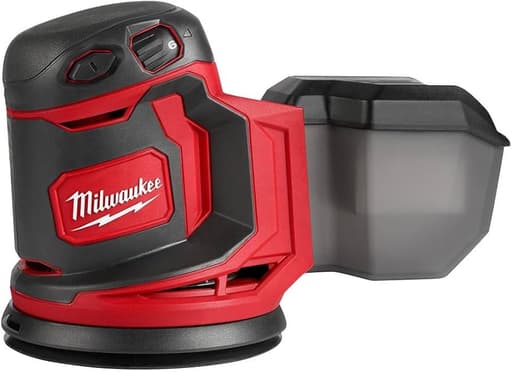
Features
- 12,000 OPM Max
- Variable Speed Control
- 5" Sanding Pad
- 3/32" Orbit Diameter
- Universal Hose Adapter Included
- Dust Canister with Filter
Specifications
| Max Speed | 12,000 OPM |
| Speed Control | Variable |
| Pad Size | 5 in |
| Orbit Diameter | 3/32 in |
| Hose Adapter | Universal (included) |
| Dust Collection | Dust canister with filter |
Related Tools
Related Articles
5-inch random orbit sander with variable speed control and a 3/32" orbit for general sanding tasks. Includes a dust canister with filter and a universal hose adapter for dust collection. Maximum no-load speed is 12,000 OPM.
Milwaukee Random Orbit Sander Review
A cordless sander that feels at home in the hand
A good random orbit sander should disappear in your hand and let the paper do the work. That’s been my experience with the Milwaukee sander. It’s a 5-inch cordless model with a modest 3/32-inch orbit and a top speed of 12,000 OPM, and it balances smooth manners with enough bite to cover most furniture, finish, and jobsite touch-up tasks. It isn’t a stock-removal monster, but for finish-focused work it’s a capable, well-thought-out tool.
Setup, ergonomics, and controls
Out of the box, the basics are right. The hook-and-loop pad grabs discs securely, the variable speed dial is easy to flick with a thumb mid-pass, and the overmolded top handle gives a natural palm grip without hot spots. The sander feels more compact than many cordless models, and with a compact battery it stays nimble for one-handed use on vertical surfaces or narrow rails. A larger pack does extend runtime, at the cost of a bit of tail-heaviness—typical for this category.
Dust management is straightforward. You get a filtered dust canister and a universal hose adapter in the box. The canister slides on positively and empties quickly. For shop or site work where dust really matters, clipping on the hose adapter and plugging into a vac is the way to go; it keeps the work surface clean, helps the paper last longer, and reduces cleanup dramatically.
Performance and surface quality
The 3/32-inch orbit tells you where this sander is meant to live: on the finish side. On maple tabletops, paint-grade poplar, and a few redwood boards, I was able to get a consistent, swirl-free surface by stepping through grits and keeping the machine moving deliberately. The pad tracks flat without wanting to tip, and the tool resists the “runaway” tendency some ROS sanders have at startup. I also noticed that it’s easy to float the pad at the edge of a panel without digging in, which is where some higher-orbit sanders can get grabby.
At the top end, 12,000 OPM is fast enough for brisk material removal with 80- or 100-grit discs. If I’m stripping a weathered board or knocking down old finish, I can keep up a steady pace without feeling like I’m waiting on the tool. That said, if you regularly chew through thick finishes or flatten large glued-up tops, a more aggressive 3/16-inch orbit sander (likely corded) will move faster. The Milwaukee sander favors control and finish quality over brute force, and it does so well.
Variable speed that actually matters
Many sanders wear a speed dial like a badge; this one uses it well. Running at moderate speeds with 150–220 grits noticeably reduces visible swirl on blotchy woods and keeps heat down when you’re feathering edges or sanding between coats. Dial it up with coarse grits to erase planer marks efficiently, then click down a couple notches as you climb past 150. The transitions are smooth, and the motor doesn’t surge or lag as you tweak the dial on the fly.
Dust collection: canister or vac
With the canister attached, collection is good for a cordless sander—especially on flat work. The integrated filter keeps fine dust from burping back out, and the canister’s clear body makes it obvious when it’s time to empty. A couple of practical notes from use:
- Seat the canister firmly until you feel it latch. If it’s only half-on, vibration can work it loose.
- Empty it frequently. An overfilled canister not only collects worse, it adds drag and can encourage the canister to creep.
- Tap out the filter or blow it clean now and then; a clogged filter hurts performance.
Hooking up a vac with the universal adapter is the real upgrade. On cabinet doors, drawer fronts, and finish-sanding jobs, dust stayed out of the air and the paper cut cleaner, longer. The adapter fit standard shop-vac hoses without fuss. If you sand a lot indoors or you’re sensitive to dust, I’d treat the vac hose as standard kit.
Vibration and control
Vibration is low for a cordless ROS. I could run it for extended sessions on furniture parts without numb fingers, and the top grip lets you steer with light pressure and a relaxed wrist. As always with ROS work, letting the machine float—no white-knuckling—produces a better finish and keeps the pad cooler.
Noise is typical for the class: not obnoxious, but absolutely in hearing-protection territory.
Runtime and power draw
Cordless sanders ask a lot from batteries, and this one is no exception. With a compact pack, I use it for shorter bursts: breaking edges, prep between coats, sanding a couple of doors, or dialing in a tabletop after scraping. For longer sessions—stripping a panel with 80 grit, for example—I prefer a higher-capacity battery. The trade-off is weight and balance, but it buys you noticeably more continuous runtime.
Two practical tips:
- Keep a second battery on the charger and rotate packs; it makes the tool feel “cordless” instead of “intermittent.”
- Don’t lean on the sander to force it; pressure doesn’t make it faster, it just burns battery and paper.
Pad quality and consumables
The hook-and-loop pad held discs reliably in my use. Like all ROS pads, heat and dust are the enemies. If you press too hard, run too fast with fine grits, or let slurry build up under the disc, you can cook the hooks and shorten pad life. I’ve kept mine healthy by:
- Brushing dust off the pad face when changing discs
- Letting the pad cool after heavy passes
- Avoiding yanking discs sideways; peel them off cleanly
- Using good paper that doesn’t shed backing fuzz
Replacement pads are available if you do wear one out, and an interface pad is a nice add-on for sanding profiles or minimizing transfer of hook pattern on delicate finishes.
Where it shines
- Furniture refinishing and cabinet work where surface quality matters
- Trim and onsite punch-list tasks without chasing a cord
- Between-coat sanding with finer grits
- Painted surfaces and light finish removal, especially paired with a vac
- Vertical and overhead work where a compact, controllable ROS is easier to manage
What could be better
- The dust canister latch can be finicky if not fully seated; a more robust detent would inspire confidence.
- Runtime is highly dependent on battery size. That’s normal for the category, but worth noting if you expect to sand continuously for long stretches.
- The 3/32-inch orbit is great for finish, less so for rapid stock removal. If heavy stripping is your life, you’ll want a more aggressive orbit or a corded option on hand.
Tips for best results
- Draw a light pencil grid on panels to track progress and prevent over-sanding edges.
- Move slowly—about an inch per second—and overlap passes by half.
- Step through grits; don’t jump from coarse to finish and expect swirls to vanish.
- Let the sander float. Too much pressure creates swirls, heat, and battery drain.
- Use the hose adapter whenever possible; cleaner sanding is faster sanding.
Recommendation
I recommend the Milwaukee sander for woodworkers, DIYers, and trim carpenters who value cordless convenience and a clean, consistent finish. Its strengths are real: smooth operation, useful variable speed, solid dust collection (excellent with a vac), and a finish-friendly orbit that helps avoid surprises when you lay down stain or topcoat. Be prepared to manage runtime with an extra battery, and take a moment to seat the canister properly or, better yet, run a vac when it counts. If you need a dedicated stock-removal machine for all-day bench sanding, a more aggressive, likely corded ROS will be faster. For everything else—especially finish sanding and site work—the Milwaukee sander is a dependable, well-behaved tool that earns its spot on the cart.
Project Ideas
Business
Mobile Furniture Refinishing Service
Offer on-site furniture refinishing for customers who don’t want to move heavy pieces. The sander’s 5" size and dust collection make it ideal for indoor, tight-space work. Position the service as low-dust and fast-turnaround: use the variable speed to adapt to veneers/solid wood and offer options (stain, paint, waxing). Scale by adding a second unit and standardized grit schedules for repeatable results.
Etsy / Marketplace Handcrafted Wood Goods
Produce small-batch goods—cutting boards, frames, coasters, shelves—using the sander for consistent surface quality. The random orbit finish reduces rework and the universal hose adapter lets you maintain a clean studio for product photography. Differentiate with unique finishes (burnt edges, inlays, mixed materials) and streamline production with jigs and repeatable sanding sequences.
Sanding & Surface Prep Service for Contractors
Offer pre-paint or pre-finish surface prep to local painters, cabinet shops, and remodelers. Price per-room or per-piece and emphasize professional prep (deglossing, smoothing, feathering edges) using the sander’s speed control and dust management to meet jobsite cleanliness standards. Create package tiers (basic prep, stain-ready, full refinish) to upsell.
Hands-On Finishing Workshops and Tool Rentals
Run small classes teaching sanding and finishing techniques (grit selection, feathering, avoiding burn-through) and rent out low-dust sanding kits to DIYers. Use the sander as the class standard—participants learn variable-speed control and dust collection best practices. Generate income from tuition, consumables (sandpaper packs), and short-term tool rentals for follow-up projects.
Creative
Reclaimed Wood Serving Boards
Turn reclaimed hardwood into live-edge serving boards and charcuterie trays. Use the 5" pad and progressive grits (80 → 120 → 220) to flatten, soften live edges and remove tool marks; the 3/32" orbit produces a fine finish with minimal swirl. Variable speed helps when sanding thin or delicate edges; use the dust canister or the universal hose adapter to keep the work area clean. Add food-safe oil finishes and optional epoxy inlays for a premium product.
Furniture Midcentury Refresh
Refinish small to medium furniture (chairs, side tables, dressers) by removing old finish, smoothing surfaces and prepping for stain or paint. The random orbit action reduces visible sanding marks and the variable speed prevents burning veneer. The dust collection keeps indoor jobs tidy. Offer distressed or smooth factory-style finishes depending on grit sequence and technique.
Handmade Toys & Miniature Furniture
Make smooth, safe wooden toys, puzzles and dollhouse furniture. Use low speeds for delicate parts and the 5" pad for quick smoothing of many small pieces (with masking/fixtures to hold tiny parts). The fine orbit and proper sanding paper will round edges to child-safe radii without taking off too much material. Finish with non-toxic paints or oils.
Decorative Concrete & Thin-Overlay Countertops
Use the sander for initial smoothing and edge work on decorative cement overlays or microcement countertops where a small pad and variable speed are beneficial. Start with aggressive grits to level trowel marks then work to finer grits for a satin finish. The dust canister and shop-vac adapter are important when working with silica-containing material—always follow PPE and dust-safety practices.