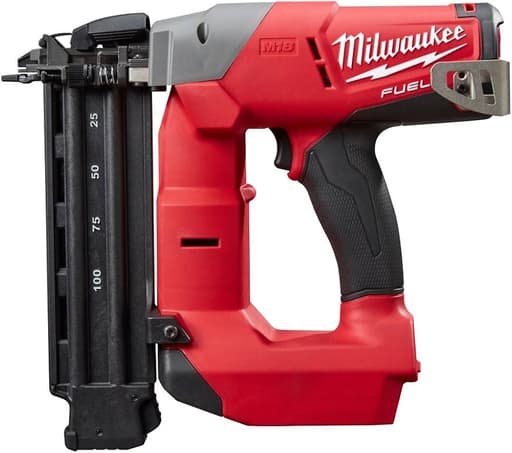
Features
- Brushless motor
- Operates without gas cartridges
- Immediate use with no ramp-up time
- Sequential and contact actuation firing modes
- LED work light
- Tool-free depth adjustment
- Dry-fire lockout to prevent damage when nails are depleted
- Non-marring nose pad to protect work surfaces
Specifications
| Fastener Gauge | 18-gauge |
| Fastener Type | Brad nails |
| Firing Modes | Sequential and contact |
| Power System | Brushless motor (cordless, no gas cartridges) |
Related Tools

Related Articles
Cordless 18-gauge brad nailer with a brushless motor that operates without gas cartridges. Designed for fast startup and supports both sequential and contact firing. Includes features to protect workpieces and the tool, and provides basic on-tool controls for depth and firing mode.
Milwaukee 18-gauge brad nailer Review
First impressions and setup
The first trigger pull told me a lot about this brad nailer. There’s no motor spin-up, no delay, just a clean, immediate shot. That instant readiness is the chief benefit of its brushless, battery-powered design: you get the freedom of cordless without the lag or the fuss of gas cartridges. Out of the box, it’s a straightforward setup—slip in a stick of 18-gauge brads, set the depth with the on-tool adjuster, choose sequential or contact mode, and you’re in business.
Build quality feels appropriately robust for jobsite use. The housing is solid, the magazine tracks nails smoothly, and the non-marring nose pad does its job of keeping delicate trim faces clean. The LED is bright enough to be useful in shadowy corners and inside built-ins, and it’s well positioned to cast light where the tip meets the wood rather than throw a vague glow.
Ergonomics and handling
Cordless brad nailers will never be as feathery as a compact pneumatics setup, and this one is no exception. That said, its balance is good enough that overhead shots and long baseboard runs don’t feel like a chore. The grip is comfortable and secure, and the trigger breaks predictably. Nose visibility is better than average; I can see my pencil lines and orient the tip accurately on tiny returns or miters.
One small note: the nose pad is gentle on painted and stained surfaces, but like any non-marring tip, it can slightly diffuse the feel of the contact point. When precision matters, I found it helpful to test a few placements on scrap before committing to a visible piece.
Firing performance: sequential and contact
In sequential mode, the brad nailer is crisp and composed. I used it on window casing, crown returns, and light cabinet trim without issues. There’s no wait for the motor to spool, so you can work quickly and rhythmically. In contact mode, it keeps up well for light production work—think long base runs or shoe molding where you’re indexing and firing in a steady cadence. It’s not a framing nailer, of course; but for an 18-gauge bradder, the consistency and speed feel confident and professional.
Noise and recoil are modest. The brushless motor contributes to a smoother, more controlled shot than older cordless nailers, and the lack of combustion smell is a quiet quality-of-life win, especially when you’re working inside a finished home.
Depth control and finish quality
Depth of drive is tool-free and easy to understand, but in practice, it’s more sensitive than I’d prefer. In softwoods (finger-jointed pine, poplar) and MDF, I could dial in a near-perfect countersink quickly. However, as materials get denser—oak, maple, or even a hard knot in an otherwise soft stick—I noticed the fine line between a clean pinhole and a proud head gets narrower. Click one way and you might leave a slightly deeper crater than ideal; click back and an occasional brad can sit just proud, especially across latewood grain.
This is fixable with a test board routine: run a few fasteners in scrap from the same batch as your workpiece, then lock your depth before you move on to the finished surface. On paint-grade trim, a quick dab of filler erases any tiny variance. On stain-grade, the margin for error is thinner. If your day-to-day includes face-frame nailing on hardwoods where you want an invisible hole every time, you’ll want to slow down, verify settings, and keep a nail set handy for the odd proud head.
Reliability, jams, and dry-fire lockout
Through several hundred shots across a mix of trim tasks, I encountered very few hiccups. Misfires were rare, and most anomalies traced back to technique—rushing a shot at a skewed angle or landing over a knot. When a brad didn’t seat all the way, it was easy enough to correct with a quick tap of a nail set. I didn’t experience chronic jamming, and the feed remained smooth with standard, quality 18-gauge brads.
The dry-fire lockout is a quiet hero feature. Rather than spit blanks and risk scarring a surface when you run out, the tool stops, saving both the driver and your workpiece. It’s the kind of safeguard you don’t think about until it prevents an annoying repair.
Working across common materials
- Pine and poplar trim: Excellent. Depth control is simple, holes are minimal, and contact mode keeps pace on long runs.
- MDF: Very good, provided you take care with edge distances to avoid crumbling. The non-marring pad and consistent firing help maintain a tidy surface.
- Oak and maple: Good, with caveats. Pre-testing your depth matters here. I adjusted my grip to keep the tool square and slowed down just a tick to ensure clean seating.
Controls and day-to-day usability
Switching between sequential and contact firing is quick and unambiguous. The control is placed sensibly and doesn’t invite accidental toggles. The LED work light is more than a gimmick—it meaningfully helps in dim corners and under cabinets. The depth dial is easy to reach, though the increments feel a bit coarse when you’re chasing perfect finish holes in hardwoods.
Since the system doesn’t rely on gas cartridges, ownership is simpler. There’s no ongoing consumable beyond nails, and there’s no gas odor or canister maintenance. Keep the nose clean, use straight, quality brads, and the tool stays reliable.
Trade-offs versus pneumatics
Compared with a compact pneumatic brad nailer and a light hose, this cordless option is heavier and marginally bulkier at the nose. If you live on a bench and want the smallest footprint for ultra-precise, stain-grade work all day, a small compressor and a micro-adjust bradder may still be your happy place. That said, for punch lists, remodels, and occupied homes where dragging a hose is a pain—and for quick trips between rooms—the convenience gain is hard to overstate. No ramp-up, no tether, and full-speed work right away.
What could be better
- Finer depth granularity: The adjuster works, but the step size can feel wide in dense hardwoods, leading to a bit more fussing to nail the perfect countersink.
- Occasional proud heads in tough grain: Not frequent, but present. Technique helps; a single extra click can swing from “just proud” to “a bit deep.”
- Weight: Expected for cordless, yet worth noting if you’re doing all-day overhead work.
Who it’s for
This brad nailer shines for remodelers, trim carpenters, and serious DIYers who value cordless convenience and immediate firing. It’s excellent for base, casing, shoe, scribe, light cabinetry trim, and punch-list fixes in finished spaces. If your work is primarily stain-grade hardwood finish where hole size and depth uniformity are scrutinized at close range, you can use it successfully—but plan on test shots and a touch more patience dialing it in.
Recommendation
I recommend this brad nailer for most trim and finish tasks where speed, mobility, and clean results matter. Its immediate firing, gasless brushless motor, dual firing modes, protective nose, and dry-fire lockout make it a dependable, low-maintenance daily driver. The main reservation is depth precision in dense hardwoods; if you routinely demand flawless, barely-there holes on stained oak or maple, you’ll want to budget time for setup and carry a nail set for the occasional proud head. For paint-grade trim, punch lists, and the wide world of general finish carpentry, it delivers the right blend of performance and convenience.
Project Ideas
Business
Trim & Finish Carpentry Service (Specialty Small Jobs)
Offer same-day or quick-turnaround finish carpentry for homeowners and short-term rental hosts: picture rails, crown/quarter-round touchups, small trim installs, and shelf mounting. The cordless, immediate-start brad nailer lets you work efficiently in occupied homes without gas cartridges and reduces setup time between jobs.
Custom Small-Home Good Shop (Etsy/Market)
Produce and sell small wood goods—frames, boxes, floating shelves, phone docks—optimized for online marketplaces. The brad nailer speeds production and provides cleaner, faster assemblies suitable for fine-finished goods. Use sequential mode for quality control on signature pieces and contact mode for bulk runs.
Mobile Repair & Staging Support for Real Estate
Provide on-call minor repair and staging support for realtors: reattaching trim, fixing baseboards, installing shallow shelving or picture rails, and prepping homes for showings. The non-marring nose and depth adjustment let you make quick cosmetic repairs without further damaging finishes, increasing home marketability.
DIY Workshop Classes and Kits
Teach small-group classes (in-person or pop-up) making simple projects—picture frames, boxes, shelves—where attendees use the nailer under supervision. Sell follow-up kits with pre-cut parts and pre-measured nail requirements and offer an add-on service for completing items using your tool (safe, no-gas operation is easier to teach).
Production Line for Event Decor Rentals
Create modular wood decor (signage, frames, pedestals) for event rental businesses. The brad nailer enables fast, repeatable assembly of delicate pieces that look finished without heavy fasteners. Use tool-free depth adjustment and dry-fire lockout to keep production steady and protect materials during high-volume runs.
Creative
Custom Picture Frames
Build lightweight, decorative picture frames from 1/4" to 1/2" moulding and thin board backing. Use the 18-gauge brad nailer to invisibly fasten corners and backer panels without splitting the moulding. Use sequential mode for precise single-nail placement on miters and adjust depth tool-free so the brad heads sit below the surface for easy filling and finishing.
Floating Shelves & Small Wall Boxes
Construct shallow floating shelves or cubby boxes from poplar or pine. The small brads are perfect for attaching thin face trim and back panels without bulky fasteners. Contact (bump) mode speeds up repetitive nailing when assembling multiple identical units; the non-marring nose pad protects finished faces during positioning.
Keepsake & Jewelry Boxes
Make small wooden boxes with delicate joinery (mitered lids, thin cleats). Brad nails provide discreet clamping while glue dries and stay nearly invisible after sanding and filling. Brushless cordless power means you can build and finish anywhere in the shop without fumes from gas cartridges.
Decorative Shiplap or Accent Wall Panels
Create a custom shiplap or beadboard accent wall using narrow boards. The 18-gauge brads hold thin boards without splitting and the dry-fire lockout prevents accidental dings when you run out of nails mid-run. Use the LED work light to align boards in low-light corners.
Small Toys & Children's Room Decor
Build simple wooden toys, picture ledges, and name plaques using thin stock. The small brads are less likely to split small pieces, and the non-marring pad keeps painted surfaces clean. Sequential mode helps when you need one precise shot per joint on delicate pieces.