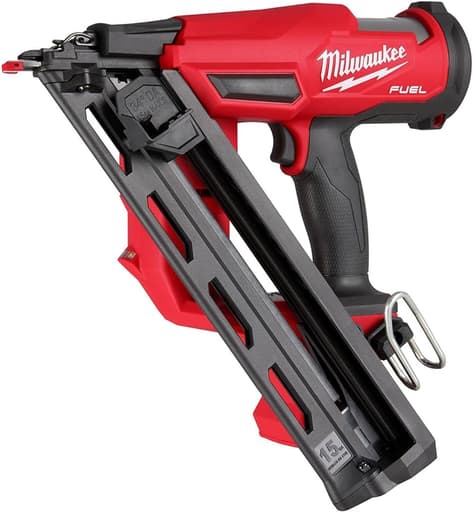
Features
- Compact, ergonomic design for use in tight spaces
- Zero ramp-up time between nail fires
- Drives up to 750 nails per charge with a compatible battery
- Compatible with all M18 REDLITHIUM batteries
- Tool-free depth adjustment
- Tool-free jam clearing
- Integrated LED work light
- Reversible belt hook
Specifications
| Gauge | 15 |
| Power Source | M18 REDLITHIUM battery (sold separately) |
| Estimated Nails Per Charge | Up to 750 nails (with a compatible battery) |
| Depth Adjustment | Tool-free |
| Jam Clearing | Tool-free |
| Work Light | LED |
| Belt Hook | Reversible |
| Design | Compact, ergonomic for tight spaces |
| Firing Behavior | No ramp-up time between shots |
Related Tools
Related Articles
Cordless 15-gauge finish nailer designed for use in confined spaces. Operates from M18 REDLITHIUM batteries and can drive up to 750 nails per charge with a compatible battery. Features tool-free depth adjustment and jam clearing, an integrated LED work light, and a reversible belt hook. The tool is designed to fire nails without ramp-up time between shots.
Milwaukee 15 Gauge Finish Nailer Review
Field use impressions
After a few weeks of trim work and a couple of prehung door installs, this 15-gauge nailer has earned a regular spot in my finish kit. The biggest change it brings is freedom from a compressor and hose without the usual cordless penalty: there’s no firing lag. Pull the trigger or bump the nose and it drives immediately, shot after shot. That “no ramp-up” behavior makes it feel much closer to a pneumatic than most battery nailers I’ve used.
Out of the box, setup is simple: slide in an M18 battery, load a strip, set your depth with the dial, and go. The tool-free depth adjust is positive and repeatable, and the tool-free latch makes clearing the occasional jam quick. The integrated LED is bright enough to help in shadowy corners, and the reversible belt hook is sturdy and actually lands the tool where you hang it.
Power and sinking performance
On typical trim—pine casing, poplar face frames, MDF baseboard—the nailer had no problem setting 2–2-1/2 inch 15-gauge nails consistently. In sequential mode (one nail per trigger pull), I could tune the depth to land just below the surface with minimal touch-up. On denser stock like red oak jambs and stair skirt board, I still got reliable sinks, but I had to be more deliberate: keep the nose planted, let the tool finish its stroke, and avoid short-stroking in bump fire. If you try to outrun the tool in contact mode on very hard stock, you may see an occasional proud nail. Switching back to sequential mode and giving the tool a firm seat solved it for me.
Depth consistency is a strong suit. Once dialed, the gun doesn’t wander between “flush” and “overdriven” the way some gas-cartridge nailers do. I never saw the driver blade chew oversized holes when set correctly, which matters on stain-grade work.
Speed and firing behavior
The lack of ramp-up time changes the cadence of work. In sequential mode, it feels immediate—no motor spin, no delay, just a clean pop. Contact (bump) mode keeps up well for typical runs of base or crown once you find a rhythm. There’s some recoil, and if you let the tool lift off the surface between shots, depth can suffer. The trick is to ride the nose firmly and let the return spring reset; after a little practice, production pace matched what I’m used to on air, just without tripping on a hose.
Ergonomics and handling
This is heavier than a pneumatic 15-gauge gun hooked to a small compressor. Battery nailers always are. The weight is well balanced over the hand, so it doesn’t feel tippy, and the handle angle puts the wrist in a neutral position for most shots at waist and shoulder height. Overhead runs with a 5.0Ah pack will remind you it’s cordless. If you swap to a compact battery, the tool gets notably nimbler without sacrificing much runtime for punch-list work.
Two ergonomic notes from my time on site:
- The non-marring nose pad is slippery on glossy paint and prefinished trim. It won’t mar, but it can slide if you’re indexing off a line. A bit of painter’s tape or a stick-on rubber pad improves grip immediately.
- The handle texture is aggressive. I didn’t blister, but on a long day I preferred thin gloves.
Runtime and batteries
On a compact 2.0Ah pack I averaged roughly 600–800 nails per charge, depending on material density and how much I lived in bump fire. That’s close to the stated “up to 750 per charge,” and more than enough to trim a room or hang a few doors between charges. If you’re already on the M18 platform, it’s plug-and-play. With a 5.0Ah battery I stopped thinking about runtime entirely.
No gas cartridges to buy, no winter startup issues, and no need to maintain a compressor—those are real advantages for small shops and remodelers.
Jams and maintenance
Jams were rare in my runs with quality fasteners. I induced a couple by mixing nail brands and once by riding the recoil too quickly on dense oak in contact mode. The front latch flips open without tools, the driver retracts smoothly, and you’re back up in under a minute. Keep the nose clean and blow out dust periodically; beyond that, there isn’t much upkeep.
Working in tight spaces
The body is compact enough to sneak into closet returns, under stair nosings, and along toe kicks where a straight-body gun struggles. The LED actually helps when you’re tucked into a dark corner, and the shorter overall length makes it easier to square up to the work. It’s not a micro pinner—plan accordingly—but for a 15-gauge nailer, it feels purpose-built for finish carpentry in modern, crowded remodels.
Finish quality
On painted work, holes were uniform and small enough that a quick pass with lightweight filler closed them cleanly. On stain-grade, the ability to set just under flush without cratered fibers was appreciated. The driver never marked the surface when depth was set correctly. Nose visibility is fine; you can see your mark without craning.
Drawbacks
No cordless nailer is perfect, and a few trade-offs showed up:
- Weight versus air: If you live on a trim cart with a compact compressor and value the lightest possible gun, you’ll notice the heft here, especially overhead.
- Nose pad traction: The non-marring tip protects surfaces but doesn’t grip slick paint well. I’d like to see a rubberized pad from the factory.
- Dense hardwoods at speed: It will set nails in hardwood, but contact mode on very dense stock can leave an occasional proud head. Sequential mode cures it; still, air has the edge when you’re racing on oak all day.
- Plastic wear parts: The small plastic nose pads are easy to misplace. Stock up or secure them; without them, you’ll want to be careful on finished surfaces.
Value and who it suits
If you already own M18 batteries, the bare tool price is easier to swallow. Compared with a quality pneumatic plus a small compressor and hose, the initial outlay for a cordless 15-gauge is higher, but the daily friction is lower: fewer trips to the truck, quicker setup, and no hose management in occupied homes. For remodelers, punch-list pros, and finish carpenters working in lived-in spaces, that convenience is worth real money. For shop-based trim crews who are already mobilized with air, the lighter weight and bottomless runtime of pneumatic still make sense.
Warranty and support
The five-year warranty on the tool is generous for a cordless nailer. Given the abuse finish guns take on site, that kind of coverage adds peace of mind.
The bottom line
The 15-gauge nailer nails the essentials: instant firing, consistent depth, strong runtime, and jobsite-friendly ergonomics. It’s not the lightest option, and you’ll want to tame the slippery nose on high-gloss surfaces, but it earns its keep by removing the compressor from most finish tasks without feeling like a compromise.
Recommendation: I recommend this nailer to remodelers, trim carpenters, and DIYers already on the M18 platform who value hose-free speed and consistent results. It’s a reliable, immediate-firing alternative to air that shines on casing, base, crown, and door hanging, with enough power for hardwood when used deliberately. If you prioritize the lightest tool possible or run dense hardwood at bump-fire pace all day, a pneumatic 15-gauge may still be the better fit. For everyone else, this cordless is a smart, time-saving upgrade.
Project Ideas
Business
Specialty Trim & Molding Micro‑Contractor
Offer focused, high‑quality trim installs (crown, base, casings) for homeowners and flippers. Emphasize fast turnaround and clean finish nailing (no visible countersinking when set right). Price by linear foot or per room, bundle pre‑finished trim for premium upsells, and use the nailer’s speed and battery runtime to handle multiple small jobs in a day for higher hourly revenue.
Mobile Property Maintenance & Emergency Repair
Target property managers and short‑term rental owners with on‑call trim/finish repairs (loose baseboards, popped nail trim after moveouts). The compact nailer and integrated LED make low‑light, tight‑space repairs fast. Sell monthly service contracts or per‑call pricing; quick response and neat, durable repairs command a premium.
Custom Shelving & Built‑In Kits + Install
Design and sell pre‑cut shelving kits online or at local craft markets, and offer installation as an add‑on. Use the nailer to produce consistent, fast assemblies in your shop and to complete installs on site. Market to small apartments and home offices; offer standard sizes for efficient production and price kits to cover material, labor, and a delivery/install fee.
Tool Rental with Training & Starter Kit
Rent cordless finish nailers (with batteries and chargers) to DIYers and weekend warriors. Include a short in‑person or video safety and technique demo highlighting depth adjustment and jam clearing. Charge daily/weekly rates plus a deposit; upsell consumables (nails) and offer pickup/dropoff to increase convenience and margins.
Content, Workshops & Plan Sales
Create short how‑to videos and paid mini‑courses teaching finish nailing techniques, trim layout, and project plans (shelves, trim packs, beadboard walls). Demonstrate the tool’s features (no ramp‑up, LED work light, jam clearing) to show efficiency. Monetize via YouTube ad revenue, Patreon, or local hands‑on workshops; sell downloadable cut lists and pricing templates for contractors.
Creative
Floating Shelves with Hidden Cleats
Build minimalist floating shelves using a hardwood cleat system recessed into the wall. The compact, ergonomic 15‑gauge nailer lets you drive nails in tight stud bays and behind the shelf where space is limited; tool‑free depth adjustment prevents blow‑through on thin shelves, and the LED work light helps line up fastens in dim corners. Make a set in maple or oak, finish with oil, and mix shelf lengths for a staggered gallery wall.
Layered Window & Door Trim Packages
Create multi‑profile trim kits (casing + backband + apron) for fast, repeatable installations. The finish nailer’s zero ramp‑up between shots and tool‑free jam clearing speeds trimming work and keeps pace on repetitive nailing. Use smaller nails for delicate mouldings and increase depth to avoid splitting. Offer pre‑stained or primed combos to sell as complete upgrade packs.
Accent Shiplap / Beadboard Wall
Install horizontal shiplap or vertical beadboard accents in a single afternoon. The ability to fire up to ~750 nails per charge (with a compatible battery) means fewer battery swaps on a full wall. The compact design lets you get into top corners and behind baseboards; tool‑free depth adjustment keeps the finish flush for painting. Try staggered boards or mixed widths for a modern rustic look.
Upcycled Furniture with Inlay & Trim Details
Refinish thrifted dressers or cabinets by adding decorative trim, beadboard backs, or routed inlays. The 15‑gauge nailer is strong enough for trim-to-wood applications but still controllable for delicate work; reversible belt hook keeps it handy while you flip pieces. Use the quick jam clearing to maintain flow when working solo on an assembly line of upcycled pieces.