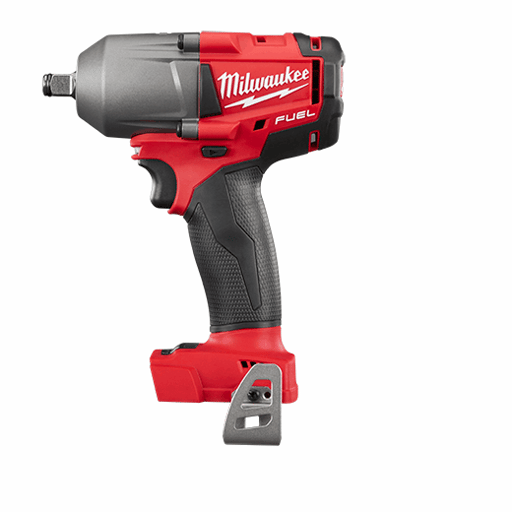
Features
- 450 ft-lbs of fastening torque
- 600 ft-lbs of nut-busting torque
- 3-mode drive control for speed and power adjustment
- Compact length for access in tight spaces
- Lightweight design to reduce user fatigue
- Integrated LED light for improved visibility
- Friction ring anvil for quick socket changes
Specifications
| Drive Size | 1/2 in |
| Fastening Torque | 450 ft-lbs |
| Nut Busting Torque | 600 ft-lbs |
| Drive Control | 3-mode drive control (speed and power adjustment) |
| Anvil Type | Friction ring |
| Integrated Light | LED |
Related Tools
Related Articles
A 1/2-inch mid-torque impact wrench designed for fastening and loosening tasks. It provides configurable speed and power through a three-mode control, uses a friction-ring anvil for quick socket changes, and includes an integrated LED for working in low-light areas. The design is compact and intended to reduce user fatigue in tight spaces.
Milwaukee 1/2 in Mid-Torque Impact Wrench with Friction Ring Review
I reach for a mid‑torque impact more than any other heavy hitter in my kit. Milwaukee’s mid‑torque has settled into that slot for me because it strikes a rare balance: enough punch for most automotive and equipment work, but compact and controllable enough to use all day without feeling like I wrestled a sledgehammer.
What stands out
- Real power in a compact package. The torque ratings (450 ft‑lbs fastening, 600 ft‑lbs breakaway) translate to real‑world results. Lug nuts, brake caliper brackets, subframe and suspension hardware—no drama.
- Three well‑spaced drive modes. The mode selector actually changes the personality of the tool, not just the top speed.
- Plug‑and‑go usability. The friction ring makes socket swaps fast, and the integrated LED covers the work area better than most.
If you’re stepping up from a budget 1/2‑inch impact, you’ll immediately notice the difference in hit rate and consistency. It doesn’t just “rattle” at a stuck fastener—it spools up and hammers decisively.
Power and speed in practice
On wheels and tires, the mid‑torque breezes through lug nuts on passenger vehicles and half‑tons. I’ve also used it on crank pulley bolts, axle nuts, and stubborn suspension bolts with convincing success. On the really gnarly, rust‑belt stuff, it’ll either crack it loose in a second or two or you’ll know quickly that it’s time for heat or a bigger gun. That honesty saves time.
What I appreciate most is the way the power arrives. Some impacts feel jumpy at the top end. This one is smooth under trigger, then delivers a firm, repeatable hit once it starts impacting. Mode 3 does the heavy lifting; Mode 2 is my default for chassis fasteners; Mode 1 is genuinely gentle for trim bolts and smaller hardware. There’s also a smart removal behavior that backs off speed once a bolt breaks free, which keeps sockets and nuts from launching across the bay.
Pro tip: for rusty fasteners, give it a second. Let the anvil hammer—don’t immediately assume it won’t break free if it doesn’t move in the first half‑second. A brief soak with penetrant, a wire‑brush on exposed threads, and a few timed impacts usually do the trick.
Ergonomics and balance
The form factor is a big reason I pack this one first. It’s shorter and lighter than a high‑torque impact, and the handle angle is friendly for working around wheel wells and underbody components. With a mid‑size battery, the balance is spot on—enough weight in the handle to counter the gearbox without feeling tail‑heavy.
Vibration is well managed. It still barks, as any impact does, but the pulse feels less fatiguing during repeated removals. The grip texture stays comfortable with gloves, and the forward/reverse selector is big enough to hit with your thumb without shifting your grip.
Control and accuracy
Three modes are only useful if they’re distinct, and they are here:
- Mode 1: low speed and light hits for small fasteners and starting nuts without cross‑threading.
- Mode 2: a sweet spot for most undercar work—snappy but controlled.
- Mode 3: full send for stuck hardware.
I use Mode 1 or 2 when running lugs back on, then finish with a torque wrench. It will absolutely over‑tighten if you let it; that’s the nature of impacts. Consider torque sticks or the low mode if you want a more conservative snug‑up before final torque.
Trigger modulation is predictable. You can feather the anvil to line up sockets and start threads, but remember this is still a high‑output tool—squeeze too deep in a high mode and you’re moving fast.
Friction ring and socket changes
The friction ring is the right call for general work. With gloves on, sockets pop on and off cleanly, and the retention is strong enough that I’m not worried when I’m working overhead. If you spend your day under lifts yanking on impact extensions over your head, a pin‑detent may feel more secure, but for me the speed of the friction ring outweighs the occasional need to tug a stuck socket free.
LED and visibility
The single LED hits the work area squarely in front of the anvil. It’s bright enough to help inside wheel wells and engine bays, though like most bezel‑mounted lights it does cast a small shadow directly behind larger sockets. I wouldn’t choose a tool based on its light, but this one is useful in real use, not just a checkbox.
Battery life and heat
With a mid‑capacity battery, I can rotate four vehicles’ worth of tires, bust loose a few suspension bolts, and still have charge to spare. Under continuous heavy impacts, the tool warms at the nose as expected. Give it a minute to cool if you’re hammering nonstop on seized fasteners; the performance stays more consistent that way. I haven’t run into thermal shutdowns during typical automotive cycles.
Durability and maintenance
After months of shop use—tires, brakes, suspension, and some equipment fasteners—the anvil shows normal wear and the friction ring still holds firmly. Keep the anvil lightly greased and wipe down the nose when it gets grimy; it keeps sockets sliding smoothly and preserves the ring. As with all impacts, avoid side‑loading long extensions to prevent premature play at the anvil.
The housing stands up to scuffs and the occasional bench drop. I’d still avoid letting it bounce around loose in a bed or box; impacts don’t love grit in their anvils.
Where it excels
- Automotive service: wheels, brakes, suspension, engine accessories
- Equipment assembly and maintenance where a high‑torque is overkill
- Tight spaces where a full‑size high‑torque won’t fit
- Users who need one do‑most‑things 1/2‑inch impact instead of a two‑gun setup
Limitations and nitpicks
- Not a high‑torque replacement. For giant axle nuts that have been rust‑welded for a decade, you’ll sometimes want the bigger hammer.
- Mode markings can be a little hard to read in poor light. You’ll learn them by feel quickly, but a higher‑contrast label wouldn’t hurt.
- The LED is good, not great. If you work mostly in low light, you’ll still want a headlamp or area light.
- Like all mid‑torques, it’s loud. Good hearing protection is a must during extended use.
Tips for best results
- Break fasteners by briefly pulsing in Mode 3, then shift to Mode 2 for removal.
- When reinstalling, use Mode 1 or 2 and stop as soon as the fastener seats; finish with a torque wrench.
- Keep a small brush and penetrant handy; two minutes of prep often saves ten minutes of hammering.
- Periodically inspect and lightly lube the anvil to keep the friction ring working smoothly.
The bottom line
This mid‑torque hits the mark: compact, genuinely powerful, and thoughtfully controlled. It’s the kind of tool that disappears into your workflow because it simply does what you ask—most of the time on the first pull—without punishing your wrists or requiring you to rearrange the vehicle around it.
Recommendation: I recommend this tool for DIYers stepping up from entry‑level impacts and for pros who want a primary 1/2‑inch that covers 80–90% of daily tasks. The combination of real torque, three usable modes, convenient friction‑ring changes, and a compact build makes it an easy choice. If your work regularly involves industrial‑grade, fused fasteners, pair it with a high‑torque for the worst cases. For everything else, this mid‑torque is the one I’d keep in the cart.
Project Ideas
Business
Mobile Tire & Roadside Fast-Response Service
Offer on-site tire changes, lug-nut removal and roadside repairs. The 600 ft-lbs nut-busting torque handles stuck lug nuts, the compact length fits into trunks and cramped wheel wells, and the LED allows safe nighttime work. Package fast, flat-rate emergency calls or annual service subscriptions for busy fleets and commuters.
Rapid Assembly Service for Pop-up Events
Provide a crew that assembles/disassembles trade-show booths, stages and exhibit structures. Use the impact wrench to speed up repetitive bolting tasks—friction-ring sockets enable quick swaps between connector sizes—reducing labor hours and allowing tighter scheduling. Offer packaged day-rates, storage between shows, and damage-resistant torque settings to avoid over-tightening client hardware.
Custom Industrial Furniture Studio
Make and sell pipe-and-plate furniture, bolt-frame shelving and bespoke metal-wood pieces. The tool's controlled torque ensures repeatable, professional assemblies and fast production runs. Upsell installation services and turnkey room sets; market finished pieces online, at makers markets, and to local cafés or offices pursuing the industrial look.
Tool Rental + Safety & Torque Workshops
Rent the impact wrench and accessory kits to hobbyists and contractors, plus offer short workshops on proper torque use, socket safety, and creative builds (furniture, art). Include value-adds like spare batteries, friction-ring socket sets and LED lighting. Workshops generate leads and equipment familiarity that drives rentals and tool sales.
Preventative Maintenance & Fleet Tightening Contracts
Sell scheduled maintenance plans to construction companies, delivery fleets and municipal services for periodic bolt retorque, wheel-checks and equipment inspections. Use the 3-mode drive control to apply manufacturer-recommended torque limits and the LED to inspect in low-light service bays. Contracts can be billed per-vehicle/per-site or as monthly retainers for steady revenue.
Creative
Industrial Pipe-and-Bolt Coffee Table
Build a heavy-duty coffee table from black pipe, flanged fittings and a reclaimed wood top. Use the impact wrench's 450 ft-lbs fastening torque for quick, consistent assembly of threaded pipe joints and the compact design to reach inside tight frame corners. The friction-ring anvil speeds socket changes when you switch between pipe sizes, and the 3-mode drive control lets you snug components by feel without overdriving the fasteners.
Nut-and-Bolt Wall Mosaic
Create a large-scale wall artwork made from an array of nuts, bolts and washers arranged like pixels or a topographic pattern. The impact wrench speeds installation of hundreds of anchor bolts into a substrate; use the low-power mode for delicate alignment and high-power mode for final seating of large anchors. The LED helps place fasteners in low-light gallery spaces, and the friction ring makes swapping small sockets fast while you work.
Upcycled Engine-Part Floor Lamp
Turn an old alternator, crank pulley or other engine castings into an industrial floor lamp. The tool's nut-busting 600 ft-lbs and compact length let you remove seized fasteners from salvaged parts, then reassemble them securely. Use precise torque control to clamp wiring housings and bulb fixtures safely; the integrated light is handy for patterning and wiring in dim garages.
Kinetic Metal Mobile or Sculpture
Design a moving sculpture made from layered metal plates, pivots and bolted linkages. The impact wrench makes it fast to install and adjust many pivot bolts while the lightweight ergonomic body reduces fatigue during overhead assembly. Use the mid-power mode to set movement pivots with the right preload so parts rotate smoothly without loosening.
Reclaimed Wood Barn-Door Hardware & Track
Craft heavy sliding door hardware for reclaimed wood doors using large carriage bolts and track fasteners. The wrench's nut-busting strength helps remove old, rusted hardware from doors; the 3-mode drive control provides fine control when securing new anchors into wood or masonry. Friction-ring anvil makes switching between hex and socket sizes quick as you move along the length of the track.