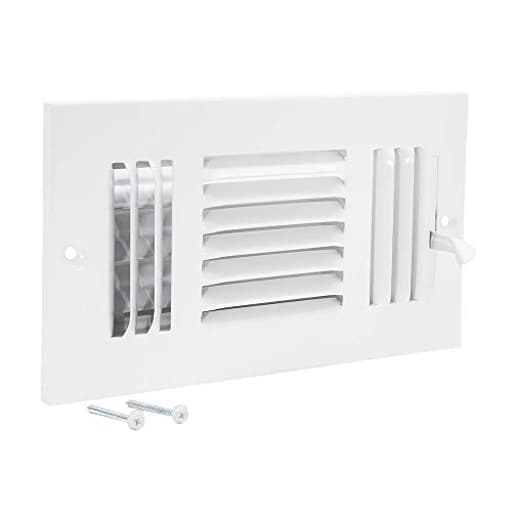
Features
- SIDE WALL AND CEILING VENT: Air vent deflector features a grille opening which measures 8 x 4 inches (WxL), and an outer dimension of 9-3/4 inch x 5-3/4 inches (WxL); features 3 vent rows
- COMPATIBILITY: Vent covers are designed for use in both sidewall and ceiling locations
- DURABLE: Ceiling and sidewall vent is composed of heavy duty steel with a white powder-coated finish which is flake resistant and provides a longer-lasting performance
- FUNCTIONALITY: This register vent cover is designed to improve air ventilation in HVAC systems, and features an adjustable damper to easily control air flow
- EASY TO INSTALL: Vent cover registers are easy to install, and includes 2 screws for installation
Specifications
| Color | White |
| Size | 8 in. x 4 in. |
| Unit Count | 1 |
![10''w x 4''h Adjustable AIR Supply Diffuser - HVAC Vent Cover Sidewall or Ceiling - Grille Register - High Airflow - White [Outer Dimensions: 11.75''w X 5.75''h]](https://images.toolstash.com/variants/9fjk2ktqv1xuyak3tn0l4dgake48/thumb.webp)
This three-way ventilation register is a steel sidewall/ceiling vent with an 8 x 4 inch grille opening (outer dimensions 9-3/4 x 5-3/4 inches) and three vent rows. It includes an adjustable damper to control airflow, is constructed from steel with a white powder-coated finish that resists flaking, and comes with two screws for installation.
EZ-FLO 8 x 4 Inch Three-Way Ventilation Steel Sidewall/Ceiling Register, Steel Duct Opening, 61658 Review
I spent a weekend swapping out a handful of tired, rusty vents in a bathroom and hallway, and this EZ-FLO 8x4 three-way register was one of the standouts. It’s a simple piece of stamped steel done right: clean lines, a useful three-way throw pattern, and an adjustable damper that actually stays where you set it. Nothing flashy, just well-executed basics at the right size and price.
What it is and why it’s different
This is a standard 8 x 4 register for a sidewall or ceiling, with an outer face that measures roughly 9-3/4 by 5-3/4 inches. The face has three rows that direct air in three directions, making it a good fit for ceilings and high sidewalls where you want to spread air across a room rather than blast it in one spot. The damper lever sits on the face, so you can fine-tune or shut off airflow without removing anything.
What set this apart for me is the execution of the basics. The steel is thicker than the bargain-bin registers I’ve installed in the past; the face doesn’t oil-can when you snug the screws, and the damper linkage feels positive instead of rattly. The white powder-coated finish is even and satiny—no thin spots, no drips—and it has held up well in a steamy bathroom.
Build quality and finish
- Steel construction with a powder-coated white finish
- Smooth edges and deburred louvers
- Lever-actuated, adjustable damper with a firm feel
On the bench, the finish resisted light scuffs from handling, and after installation in a bathroom that sees daily showers, I didn’t see any early corrosion or flaking. Powder coat isn’t magic, but in my experience it’s more durable than a quick spray enamel, especially in damp locations. The louvers are cleanly stamped with no burrs, so there’s less chance of snagging a cloth during cleaning.
The damper mechanism feels deliberately tight. It takes a bit of force to move from fully open to closed, but that stiffness is an asset once it’s set; the lever didn’t drift with airflow or vibration.
Installation experience
This is a straightforward swap if you’ve done HVAC registers before:
- Nominal size refers to the duct opening. Measure the rough-in: you want an 8 x 4 inch duct opening. The face is larger (about 9-3/4 x 5-3/4) to cover the cutout.
- Two matching screws are included. They’re fine for wood framing at the duct edge or for biting into existing holes in metal boots. I liked that the screw heads match the finish.
- The frame sits flat against the surface. On slightly uneven drywall or old plaster, a thin strip of foam tape behind the top edge helped eliminate any minor gaps.
On one of my older metal boots, the factory screw holes were set slightly wider than the holes on this register. That’s not unusual; hole patterns vary by brand and age. I widened one hole with a step bit and drove the included screws—quick fix, but worth noting if you’re counting on a no-drill install. If you’re installing into ceiling drywall with no wood lip or where the old holes are stripped, use anchors or move the holes slightly for a firm mount.
Fit-wise, the body slips into a correctly sized opening without interference. If your drywall cutout is tight or out of square, a couple of passes with a rasp can make the face sit true.
Airflow and performance
Three-way registers shine in rooms where you want to distribute air broadly. Installed on a ceiling above a hallway branching into rooms, the pattern throws air left, right, and forward, which reduced the hot–cold spots I had with a one-way register. In the bathroom install, spreading conditioned air kept the mirror from fogging as quickly, and closing the damper halfway helped balance the system so the adjacent bedroom wasn’t starved.
Noise is often the tax you pay for airflow control, but this one is quiet at typical residential static pressures. With the damper half closed on a higher-flow branch, I heard a modest hiss—expected for any register—but no rattle from the face or lever. The stiffer damper linkage helps here.
Compatibility and sizing tips
- Measure the duct opening, not the old faceplate. If your existing grill measures roughly 10 x 6 across the face, it likely covers an 8 x 4 opening—this register should be the right nominal size.
- For ceiling installs, a three-way pattern is ideal when the register sits near a wall. If your register is centered in a room, a four-way might distribute air more evenly; for a wall boot near a door, two-way can be better to avoid blasting the door.
- If you’re matching several rooms, keep the style consistent. This profile and finish are common enough that it blends with most white trim and ceiling paints.
The screw holes are in line with the long dimension, which suited most of my boots. If your old register used corner screws, plan to drill new pilot holes.
Durability and maintenance
After a few months in a humid bathroom, the finish still looks new. I wipe registers with a damp cloth when I clean filters; the powder coat didn’t chalk or stain, and lint didn’t catch on the louvers. There’s no foam gasket behind the face, which is standard for stamped steel registers. If you want an air-tight seal against the wall or ceiling, add a thin bead of painter’s caulk or apply narrow weatherstrip around the backside before you mount it.
The damper plate hasn’t loosened or started to chatter, and the lever still holds position. If you plan to adjust dampers seasonally, that kind of consistency matters.
Where it makes the most sense
- Bathrooms, kitchens, and laundry rooms where humidity is high
- Ceiling or high sidewall locations that benefit from a three-way throw
- Quick cosmetic refreshes where rusty or yellowed vents are letting the room down
- Budget-conscious upgrades without stepping down to flimsy, tinny alternatives
If you’re in a coastal environment, any steel register will eventually show wear, but a good powder coat like this buys you time and looks better, longer.
What I’d change
- Slightly more generous slotting at the screw holes would accommodate more legacy boots without drilling.
- A thin factory-applied foam strip around the backside would help first-time installers achieve a clean seal on uneven drywall.
- The lever could use a tiny visual indicator for fully closed and fully open positions; you can feel it, but a mark would be helpful.
None of these are dealbreakers, and they’re common asks in this category.
Value and alternatives
You can go cheaper with ultra-thin stamped steel registers, but they tend to flex, chip, and rattle sooner. Plastic registers won’t rust, which is attractive in bathrooms, yet they can discolor over time and often have sloppier dampers. On the higher end, aluminum or decorative patterned registers look great and resist corrosion better, but they cost several times more and often skip adjustable dampers.
This EZ-FLO sits in a sensible middle: solid steel, durable finish, adjustable control, and a clean profile that doesn’t call attention to itself.
Bottom line
I installed the EZ-FLO 8x4 three-way register in both a bathroom and a hallway ceiling and came away impressed with the build, the finish, and the airflow control. It installs easily if your duct opening is true, the damper holds position without rattling, and the powder coat has shrugged off daily humidity without flaking. Be prepared to drill new pilot holes if your existing boot’s screw pattern doesn’t line up, and consider adding a thin gasket if you want an airtight seal. For most sidewall and ceiling applications, especially where you want to spread air instead of aiming it in a single direction, it’s a smart, reliable choice.
Recommendation: I recommend this register. It combines sturdy construction, a durable powder-coated finish, and a practical three-way throw with an adjustable damper, all at a reasonable price. As long as you verify the nominal 8 x 4 duct opening and are comfortable making minor adjustments for screw alignment if needed, it’s an easy upgrade that improves both the look and the performance of your HVAC outlets.
Project Ideas
Business
Custom Decorative Vent Covers
Offer a line of custom-painted and laser-cut decorative 8x4 vent covers targeting homeowners and renovators who want small-scale aesthetic upgrades (bathrooms, closets, laundry rooms). Value-adds: powder-coat touch-up for color matches, stenciling, decals, and pre-attached magnetic filters. Price as premium home accents, sell individually or in multi-packs through Etsy, Instagram, and local hardware stores.
HVAC Micro-Upgrade Kits for Rental Units
Create a plug-and-play kit for landlords and property managers: include several of these 8x4 registers, adhesive thermal seals, foam dust filters sized to fit, and quick-install instructions. Position the product as a fast, low-cost way to improve airflow control and energy efficiency in small rooms. Market via B2B channels to property management companies and local contractors.
Workshop Organizer Panels
Sell modular 8x4 vent panels repurposed as tool and cable organizers for makers and small shops. Pre-drill variants for screw-in hooks, include a pack of matching steel hooks, and offer bundled sets that mount on slatwall or pegboard. Emphasize durable steel construction and the compact footprint for tight workspaces. Offer wholesale pricing to makerspaces and craft stores.
DIY Tiny Fan Vent Kits
Assemble a small electronics kit that pairs the register with a micro USB fan, foam filter, and mounting bracket to make compact room fresheners, CPU case vents, or terrarium ventilation modules. Provide instructions and safety notes; market to hobbyists and aquarium/terrarium owners who need discreet airflow. Sell kits online with tiered options (basic vent + fan, premium with charcoal filter and speed controller).
Creative
Mini Wall Jewelry Organizer
Turn the 8x4 vent into a slim wall-mounted earring and necklace holder. The three vent rows make perfect slots for hanging stud earrings, hoops, and necklace chains; the adjustable damper can be bent slightly to create hooks for rings. Paint or decoupage the white powder-coated steel to match décor, mount with the included screws or use adhesive strips, and mount multiple registers in a grid for a statement organizer.
Industrial Photo Shadow Box
Use the vent as the front face of a tiny industrial-style shadow box. Build a shallow wooden box sized to the register, place a thin backboard for photos or small keepsakes, and secure the vent as a protective grille. The three-way slats create interesting shadows on the photos; leave the damper movable so you can change the light pattern. Finish wood with stain for a rustic look.
Herb Drying Strip
Create a space-saving herb dryer by mounting several registers horizontally under cabinets or in a pantry. Hang small bunches of herbs through the slats or tie them to the damper. The steel construction tolerates heat and humidity; add a removable mesh behind the grille to catch leaves. Multiple registers make a modular drying rack you can expand as needed.
Dollhouse / Miniature Adjustable Shutters
The 8x4 register makes an ideal tiny shutter or vent for dollhouses and scale models. Use the adjustable damper as a functional shutter that opens and closes, adding realism. Paint to match the miniature building, and screw into place or glue for permanent installs. The steel grille reads as industrial or modern architectural detail in dioramas.