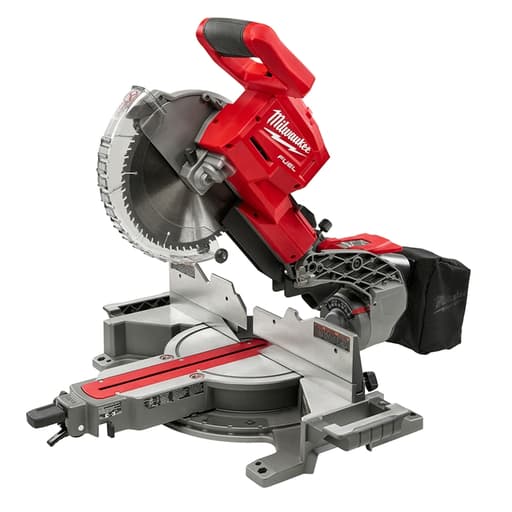
Features
- POWERSTATE brushless motor
- Adjustable stainless-steel detent plate
- Easy-access bevel adjustment
- Shadow Cut Line LED alignment indicator
- Top and side carrying handles
Specifications
| Blade Size | 10-inch |
| Bevel Type | Dual bevel, sliding compound |
| Motor | POWERSTATE brushless motor |
| Detent Plate | Adjustable stainless-steel detent plate |
| Cut Alignment | Shadow Cut Line LED |
| Handles | Top and side carrying handles |
Related Tools
Related Articles

A 10-inch dual-bevel sliding compound miter saw with a brushless motor. It includes adjustable bevel settings, a stainless-steel detent plate, an LED alignment indicator, and top and side handles for carrying.
Milwaukee 10-inch Dual Bevel Sliding Compound Miter Saw Review
Why I reached for this saw
I picked up the Milwaukee 10-inch slider to cut down on trips to the truck and to keep a compact, accurate miter station on smaller jobs. A brushless motor, dual bevel, and a shadow-line LED in a body light enough to carry with one hand sounded like the right balance of portability and capability. After months of trim, flooring, built-ins, and a smattering of site work, here’s how it actually performs.
Build, setup, and first cuts
Out of the box, the saw feels well put together. The adjustable stainless detent plate engages crisply on common angles, and the head pivots smoothly through its dual-bevel range. I appreciate the easy-access bevel adjustment—no hunting around the back for a tiny lever with your knuckles wedged against a wall. The top and side handles make single-person carry straightforward, even up a flight of stairs.
Initial calibration mattered. Out of the box, my unit was close but not perfect: the miter zero was a hair off and the bevel stopped a touch shy of dead 90. Five minutes with a square and a Torx driver brought everything in. If you do fine trim, plan on this step—don’t assume factory-perfect alignment.
The Shadow Cut Line LED is a genuine asset. Unlike a laser that drifts with blade changes, the shadow shows the blade’s actual kerf, and it’s visible indoors and out. For repeated casing cuts and picture-frame miters, it speeds things up without forcing me to muscle a work light into place.
Portability and ergonomics
This saw is built to be moved. The footprint is manageable on a rolling stand or a small bench, and the carry handles are well-placed. The head lock-down and rail lock are positive, so it doesn’t slop around when you’re moving between rooms.
The trigger and handle geometry are comfortable for right- or left-hand operation. One gripe: the safety/trigger linkage feels more delicate than I’d like on a jobsite tool. Mine started to feel sticky after a few months in dusty remodel environments, and later required parts replacement when the power cut intermittently on startup. More on reliability below.
Accuracy and repeatability
With a good blade and fresh calibration, the Milwaukee 10-inch slider produces clean, tight miters suited to paint-grade trim and built-ins. The detents are confidence-inspiring, and the miter lock engages positively. For crown and detailed moldings, the shadow line and a zero-clearance fence/aux table get you most of the way to a dialed setup.
That said, there are a few caveats:
- Slide contamination: The rail design sits in the path of dust discharge, and chips collect quickly. If you don’t brush or blow the rails frequently, the slide gets gritty and can introduce a small start/stop feel mid-cut. It’s manageable with maintenance, but it’s there.
- Fence rigidity: The stock fence is adequate, but the extended sections flex more than on heavier shop saws. For exacting cabinet work, I clamp on a straight, taller sacrificial fence to improve support.
- Side load sensitivity: Rushing a long bevel cut or pushing hard sideways will show you a little deflection. Technique fixes most of it—let the blade do the work—but on ultra-precise finish work, I slow down and use auxiliary support.
Bottom line: it’s accurate enough for most trim and finish on site, but if you demand furniture-grade tolerances all day, every day, a heavier, more rigid platform is easier to live with.
Power and cutting performance
The brushless motor has plenty of snap for a 10-inch saw. Crosscuts in framing lumber, baseboard, and hardwood flooring feel effortless with a sharp blade. Wider compound cuts require patience—exactly what I expect from a compact slider—but the saw tracks fine at a reasonable feed rate. Compared to beefier corded shop saws, this is a notch down on sheer torque, but the trade-off is portability.
Switching to a high-output battery markedly improves sustained power under load and reduces the chance of a stall on wide cuts. If you plan to cut dense hardwoods or piles of trim, budget for the bigger packs.
Bevel and miter adjustments
Milwaukee got the user interface mostly right:
- Front-facing bevel release is easy to reach.
- Positive stops on common bevels and miters are consistent once you’ve tuned them.
- The miter lock engages solidly, but the cam can loosen with travel. A periodic check to keep it snug is part of my routine.
I also like that the scale markings are high-contrast and legible under the LED. Small thing, big quality-of-life improvement.
Dust collection and maintenance
Dust capture is average with a vac attached and below average if you rely on the bag. The back of the saw throws a fair percentage of chips, and as mentioned, the rails collect debris quickly. My maintenance routine:
- Brush the rails every few cuts; a quick blast with compressed air at break time.
- Wipe the rails and apply a light dry lube—avoid oils that trap dust.
- Keep the detent plate and miter lock free of packed dust; a tiny bit of debris under the plate can feel like a soft detent.
- Check fence alignment after a knock or tip; it doesn’t take much to nudge it.
These habits keep sliding action smooth and accuracy steady through a long day.
Safety and controls
The shadow-line light doubles as a task light, which is helpful on dim sites. Guard action is predictable, and the electric brake stops the blade quickly. My unit developed an intermittent power issue after a couple of years—pull the trigger, light comes on, motor hesitates, then spins up or cuts out. Reseating the battery and cleaning contacts helped short term; ultimately I needed the switch/electronics serviced. It’s a reminder that compact, electronics-heavy saws can be pricier to fix than old-school corded units.
What I’d change
- Better protection for the slide rails from dust discharge.
- A beefier fence and more rigid outer extensions.
- A more robust trigger/safety module with sealed internals to resist dust and survive knocks.
- Improved dust shrouding; this platform would benefit from a more focused pickup at the blade.
Tips to get the most from it
- Calibrate miter and bevel out of the box, then log your settings for quick rechecks.
- Upgrade to a high-quality, application-specific blade (fine crosscut for trim; alternate top bevel for flooring).
- Add a zero-clearance fence and base to support small moldings and reduce tear-out.
- Clean and dry-lube the rails regularly; expect to do this more often on cutting stations without dust extraction.
- If you feel slide grit, stop and clean—forcing it will wear the bushings and harm accuracy.
- Check the miter cam tension monthly and snug it if you notice play.
Who it’s for
- Great fit: Remodelers, trim carpenters, and punch-list pros who value portability, quick setup, and a reliable cut line on a compact 10-inch platform.
- Works with caveats: Finish carpenters who demand cabinet-grade precision can make it sing with careful setup and technique, but may prefer a heavier, more rigid saw for shop-built work.
- Not ideal: Users who won’t maintain sliding rails or who need absolute dead-nuts accuracy under heavy side loads all day.
Recommendation
I recommend the Milwaukee 10-inch slider for jobsite trim, flooring, and general carpentry where portability and a precise, easy-to-see cut line matter. The brushless motor has enough power for a 10-inch class saw, the detents are trustworthy once dialed, and the shadow-line LED speeds layout in real-world lighting. However, it rewards maintenance: keep the rails clean, verify calibration, and consider auxiliary fences for delicate pieces. If your work skews toward cabinet-grade precision or you’re sensitive to potential electronics/trigger repairs down the road, a heavier, more rigid platform may suit you better. For everyone else who wants a capable, compact slider that’s easy to carry and fast to set up, this one earns its place on the truck—with eyes open to the upkeep it expects.
Project Ideas
Business
Mobile Mitering Service for Contractors/Homeowners
Offer an on-site cutting service: drive to remodels and make precise trim, door, and window cuts in place. The saw’s top and side carrying handles make transport easy; dual-bevel and sliding capacity allow on-site solutions for crown molding and oversized stock, reducing waste and callbacks.
Custom Frame & Trim Shop (Online + Local Pickup)
Set up a small shop making custom picture frames, mirror frames, and decorative trim kits sold online. Use the detent plate for repeatability, the LED shadow indicator for precision, and the brushless motor to handle steady production runs. Offer measured-to-fit and framing kits for photographers, galleries, and homeowners.
Pre-Cut Molding & DIY Trim Kits Subscription
Create a subscription or one-off service delivering pre-cut molding and trim packages for common renovation projects (window casings, door surrounds, baseboards). Use the saw’s adjustable detent stops and bevel settings to produce kits that fit typical dimensions, saving DIY customers time and reducing installation errors.
Tool Rental + Quick Training Package
Rent the miter saw for weekend DIYers with an added short training session or video guide demonstrating safe bevel adjustments, detent plate use, and Shadow Cut alignment. The saw’s portability and easy-access bevel control make it attractive to renters who need quick, accurate cuts without committing to a purchase.
Small-Batch Home-Decor Production (Etsy/Markets)
Produce small-run home decor items—floating shelves, picture ledges, planter boxes, and geometric wall art—using the detent plate for fast, repeatable cuts. Market higher-margin custom sizes or finishes; the POWERSTATE brushless motor and sliding capability will keep throughput high while maintaining accuracy for consistent product quality.
Creative
Custom Picture Frame & Shadow Box Sets
Use the 10" blade and adjustable stainless-steel detent plate to cut precise 45° miters and repeatable corner joints for picture frames and shadow boxes. The Shadow Cut Line LED helps you align delicate inlays or mats before cutting, and the small footprint + carrying handles makes it easy to take frames to a client or craft fair.
Crown Molding & Complex Trim Packages
Leverage the dual-bevel sliding compound action to cut crown molding and compound angles accurately — ideal for inside/outside corners and irregular wall angles. The brushless motor keeps power consistent through long runs, and the detent plate lets you batch-cut identical pieces for built-ins or custom trim jobs.
Angled-Leg Live-Edge Bench
Build a live-edge bench using the sliding feature to crosscut wide slabs and the bevel settings to cut matching angled legs and joinery. The LED alignment indicator lets you preview cut lines on expensive stock, while the saw's portability helps you bring the tool to large slabs in a garage or workshop.
Multi-Strip Inlayed Cutting Boards & Cheese Boards
Create patterned cutting boards by ripping (with a table saw alternative) then using the miter saw for repeatable crosscuts and miters for inlaid strips. The POWERSTATE brushless motor handles repeated cuts without bogging down, and the detent plate ensures each board’s pieces are identical for small batch production.
Custom Stair Skirts & Baluster Kits
Produce matched sets of stair skirt boards, riser trim, and baluster tops using the detent plate for consistent angle stops and the sliding compound action for taller boards. Portability lets you set up at a jobsite to fine-tune cuts and reduce installation time.