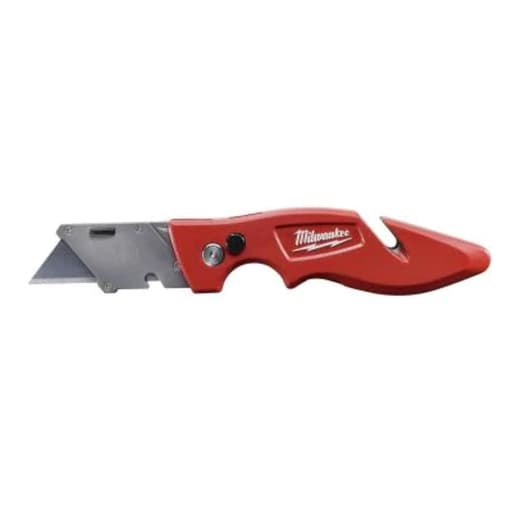
Features
- One-handed press-and-flip opening
- Tool-free blade change
- All-metal body
- Integrated gut hook
- Integrated wire stripper (cuts up to 10‑gauge)
- Blade holder designed for scoring
- Metal extension to help prevent accidental blade removal
- Wire-form belt clip
- Tether-ready lanyard hole
Specifications
| Height | 1.05 in |
| Length | 9.9 in |
| Width | 3.3 in |
| Blade Length | 1 in |
| Color | Red |
| Handle Type | Ergonomic |
| Material | Metal |
| Weight | 0.335 lb |
| Number Of Pieces Included | 1 |
| Pack Quantity | 3 |
| Warranty | Limited Lifetime Warranty |
Related Tools
Related Articles
Folding utility knife with a one-handed press-and-flip opening. Allows tool-free blade changes and includes an all‑metal body, an integrated gut hook and wire stripper, a blade holder for scoring, a metal extension to reduce accidental blade removal, and a wire‑form belt clip. Has a lanyard hole for tethering.
Milwaukee Flip Utility Knife Review
A folding utility knife that earns pocket time
I carry a utility knife almost every day, and the Milwaukee flip knife has edged out most of my others for one simple reason: it’s quick and predictable without feeling disposable. After months of jobsite use—breaking down boxes, trimming drywall, slicing carpet, and doing light electrical—this little red folder has become a regular in my pocket.
Design and build
This is an all‑metal, folding utility knife with a one‑handed press‑and‑flip opener. At about 0.335 lb, it’s not featherweight, but the heft inspires confidence when you’re pushing through dense material. Open, it’s roughly 10 inches from butt to tip with about an inch of blade exposure—typical for a standard utility blade holder. The handle shape is simple, slightly contoured, and fills the hand better than a lot of thin-bodied folders. I can bear down on it with a gloved hand without hotspots at the pivot.
Milwaukee’s wire‑form belt clip is one of the understated wins here. It slides over pocket hems easily, doesn’t over-clamp, and hasn’t chewed up fabric. The lanyard hole is sized for cord or a small tether clip; on ladders or lifts, I’ll tie in a short coiled tether and the balance stays neutral.
The coating will show wear. Mine is more scuffed silver than red now, but the underlying metal hasn’t dented or bent. I’ll take honest wear over fragile coatings any day.
Opening, lockup, and safety
The press‑and‑flip opener is exactly what it sounds like: press the button with your thumb and flick your wrist to swing the blade holder out. It’s a natural motion, even with light gloves, and it’s faster than most slide‑out retractables. The lockup is positive and has stayed consistent; I haven’t had accidental unlocks while cutting.
One smart addition is the metal extension around the blade release. It acts like a guard, reducing the chance that palm pressure or material sliding along the spine will accidentally hit the release and dump the blade. You can still change blades without tools—more on that below—but the guard adds just enough insurance when you’re cutting overhead or at awkward angles.
For quick cuts where you don’t want the blade fully exposed, the closed-position gut hook is genuinely useful. It’ll zip through tape, twine, plastic banding, and zip ties without flipping the knife open. If you sling a knife countless times a day, every avoided flip adds up.
Blade changes and scoring
Blade changes are tool‑free and straightforward. Press the release, slide the old blade out, slide a new one in until it clicks. The retention is secure; I haven’t had blades walk out or rattle loose. The “scoring” intent of the blade holder is a nice nod to people who do a lot of drywall or rigid foam—there’s just enough nose and support to keep the blade tracking straight without flex. With fresh blades, I get clean, predictable score lines in gypsum and foam board.
A note on compatibility: it takes standard trapezoid utility blades. Keep a small pack on hand, swap often, and your cutting performance will always feel “like new” without any drama at the pivot.
Cutting performance
Cardboard and packaging: It stays stable under diagonal cuts and long rips. The balanced handle keeps the nose from diving when you’re pulling toward you, and the guard around the blade release means your palm can ride the spine without worry.
Drywall and foam: Scoring is predictable thanks to the rigid holder. With an inch of exposure, you get good control without over-committing depth.
Flooring and carpet: Plenty of leverage for pull cuts. The handle’s smooth edges don’t bite when you’re working from the hip.
Plastic strapping and twine: The closed gut hook is faster and safer than flipping open for quick snips.
Electrical odds and ends: The integrated wire stripper is rated up to 10‑gauge. It works—especially for quick trims or when your real strippers aren’t on you—but it’s not a replacement for dedicated strippers. I use it for quick jackets and pigtails in a pinch. The key is to pull straight and steady; twist and you’ll nick copper.
With standard blades, this isn’t a prying tool, and it won’t love being torqued sideways in sheet goods. Keep it in the cutting lane and it rewards you with predictable results.
Ergonomics in daily carry
The handle is comfortable in a hammer grip or pinch grip, and the button falls under the thumb naturally. One-handed opening is reliable with bare hands and light gloves; in thick winter gloves, I can still open it, but I need a more deliberate flick. The wire‑form clip sits low enough not to snag, and because it’s rounded, it doesn’t grind on truck seats or lift harnesses.
There’s no onboard blade storage, which some folks will miss. Personally, I’d rather keep the handle slim and slip a five‑pack of blades in my pouch. If onboard storage is a must-have, look to a different style; otherwise, the trade-off here is a slimmer, cleaner handle.
Durability and maintenance
After months of use, the pivot on my knife is still snappy. Dust and drywall powder will slow any mechanism, so I blow it out with compressed air and add a drop of light oil to the pivot every few weeks. The lock tolerances remain tight—no meaningful blade wobble—and the button spring hasn’t softened.
The all‑metal body shrugs off drops and doesn’t flex under normal cutting pressure. If you do roofing or work in wet conditions, swap blades before they rust rather than trying to nurse a dull one. The knife itself has held up fine in occasional rain; I just dry it and move on.
Milwaukee backs it with a limited lifetime warranty. With a tool this simple, that gives me confidence that the mechanism is built to last, not designed to be tossed.
What I’d improve
Add optional blade storage: I don’t need it, but many tradespeople prefer carrying a couple of spares onboard. This model keeps things slim and skips storage; that’s a deliberate design choice but worth noting.
Heft vs. long shifts: At about a third of a pound, it’s not heavy, but those who count grams might prefer a plastic-bodied folder. I see the weight as part of the robust feel; your mileage may vary.
Wire stripper learning curve: It works best with straight pulls on known gauges. Try to make it do everything and you’ll nick conductors. Treat it as a convenience, not a replacement for real strippers.
Glove performance: The opener is usable with bulky gloves, but the flick requires a firmer motion. Not a deal-breaker, just plan on a slightly more deliberate open in winter.
Who it’s for
Tradespeople who need fast, one‑handed deployment and a sturdy, pocketable knife that lives in work pants without fuss.
Facility and warehouse staff breaking down boxes all day, where the closed gut hook legitimately saves time and reduces unnecessary blade exposure.
Remodelers and DIYers who do a mix of scoring, trimming, and general utility work and appreciate a knife that feels more “tool” than “giveaway.”
If you cut more foam and drywall than anything else and rarely need a foldable, a fixed‑blade utility might be a better choice. If you prioritize ultra‑light carry above all, a plastic slider will be lighter. But for a durable, one‑handed folder that covers the widest range of daily tasks, this one is well sorted.
Bottom line
The Milwaukee flip knife nails the fundamentals: quick one‑handed opening, secure lockup, tool‑free blade changes, and a comfortable all‑metal handle that holds up to jobsite abuse. The wire‑form clip and closed gut hook make it genuinely faster to live with day to day, and the tether-ready lanyard hole is practical for anyone working at height. I’d love onboard blade storage as an option, but I don’t miss it enough to give up the slim profile.
Recommendation: I recommend it. If you value reliable one‑handed operation, a durable body, and small quality-of-life features that actually get used—like the gut hook and protected blade release—this knife earns its keep. It’s a straightforward, well-executed design that holds up to real work without getting in your way.
Project Ideas
Business
Knife-Forward Maker Class Series
Run hands-on workshops teaching safe one-handed cutting techniques and project builds (wallets, lamps, stencils). Sell class tickets and package the Flip Utility Knife as part of a premium kit. Use the tool's safety features (tetherable lanyard hole, metal extension) in curriculum to reassure beginners and upsell blade refill packs and leather/stencil supplies.
Custom Branded Utility Kits
Offer branded Flip Utility Knives as corporate gifts or tradeshow merchandise with color/logo customization and bundled spare blades, a small leather sheath and a maintenance card. Target contractors, outdoor brands and maker spaces. The one-handed open and durable metal body are strong selling points for promotional clients seeking practical, premium swag.
Micro-Manufacturing for Local Retail
Set up a small production line making custom cut goods (stencils, greeting-card popups, fitted packaging inserts) using the knife for quick, repeatable scoring/cutting. Market to local boutiques, breweries and event planners who need small runs or same‑day fulfillment. Offer blade-safe assembly and labeling services; sell replacement blades and starter kits as add-ons.
Field-Service Accessory Sales for Trades
Create and distribute jobsite accessory packs aimed at electricians, carpenters and outdoor guides: Flip Utility Knife + blade refill set + tether lanyard + toolkit pouch. Promote the integrated wire stripper and ergonomic metal body as trade-ready features. Sell direct to contractors via subscription replenishment (monthly blade packs) or through distribution to hardware stores.
Creative
Precision Leather Wallets
Use the Flip Utility Knife's blade-holder scoring edge to mark folding lines and the gut hook for smooth curved cuts on leather. The tool-free blade change speeds switching between skiving, trimming, and finishing blades. Its all‑metal ergonomic body gives control for tight seams; produce a small line of handcrafted leather wallets, cardholders and rounded-coin pouches with clean, repeatable edges.
Linocut & Stencil Printshop
Use the short 1" blade and scoring feature to carve linoleum or stencil plastic for screen-prints and posters. One-handed press-and-flip opening and quick blade swaps make detailed work faster. Offer limited-edition art prints, custom stencils for local businesses, or layered stencil kits for crafters looking for crisp, repeatable cuts.
Scale Modeling & Scenic Detail
For terrain, dioramas and scale models, use the knife for precise scoring, trimming foam board, balsa wood and plastic. The integrated wire stripper is handy for preparing lamp/LED wiring in miniature builds. The metal extension reduces accidental blade removal when applying pressure on tiny parts. Create realistic scenery kits, custom model parts or diorama commission services.
Folded Cardboard Lamps & Sculptures
Design geometric lampshades, room dividers or sculptural pieces from scored cardboard or corrugated board. Use the blade holder for long, consistent score lines that fold cleanly, and the gut hook for controlled curve cuts. Produce finished light fixtures with interior LED wiring prepped using the wire stripper and sell as eco-friendly home décor.