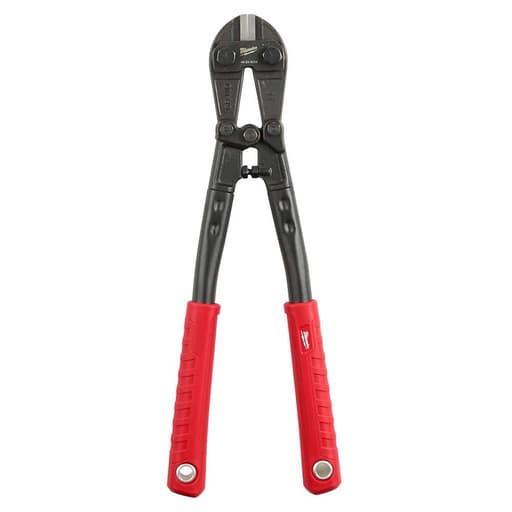
Features
- Forged-steel blades for extended life
- Bolt lock to prevent loosening
- Adjustable blades/blade alignment
- Comfort grip handles
- Integrated lanyard holes
Related Tools


Related Articles
Hand tool for cutting bolts and similar metal fasteners. Features forged-steel cutting blades for durability, an adjustable blade mechanism for alignment, a locking bolt to prevent loosening during use, comfort grip handles for user control, and integrated lanyard holes.
Milwaukee Bolt cutter Review
First impressions and setup
I put these Milwaukee cutters straight to work the day they arrived. Out of the box, the build feels serious: forged-steel jaws, beefy pivot hardware, and contoured grips that don’t feel plasticky or hollow. There’s also a thoughtful pair of lanyard holes at the handle ends—handy if you’re working at height or just want a tether point in a crowded truck bed.
Before I made the first cut, I did have to sort out the adjustments. Mine arrived with the blade alignment bolts cranked a bit too tight, which left the jaws barely able to open. If yours won’t open fully, don’t force it. Back off the two small adjustment screws at the head evenly, open the handles to spread the jaws, then bring the screws back in until the blades just meet at the apex. Lock them down with the nuts. The larger pivot bolt includes a locking feature to prevent it backing out, so once you’ve got the alignment dialed, it stays put. I wish there were clearer markings or a quick-start tag explaining this—once I adjusted it, operation was smooth, but that first five minutes can be a head-scratcher.
Build quality and ergonomics
The forged jaws look the part, and the surface finish on my set was clean with no burrs from the factory. The handles are straight and moderately thick, and the grips have enough cushion to keep the tool from feeling slippery under load without being so soft that they twist in your hands. Balance is slightly head-heavy—as you’d expect with a compact bolt cutter—but not to the point of being unwieldy. I could carry and position it one-handed without fighting the nose.
The hinge action is tight in a good way: no lateral slop, and the bolt lock does its job of preventing the pivots from drifting during repeated cuts. After a week of daily use, I checked the hardware and found nothing backed off.
Cutting performance: the good
I tested across the kind of materials most people are likely to encounter:
- Mild steel bolts and all-thread: Up through common 1/4-inch zinc-plated hardware, the cutters zipped cleanly with a firm squeeze. For 5/16-inch mild steel all-thread, I needed both hands and a grounded stance, but the cut was controlled and left only a light burr.
- Chain-link fence ties and light chain: No drama here. The cutters bite predictably without walking off the material.
- Aluminum rod and copper ground wire: As expected, these are easy cuts. The jaws didn’t mash or flare softer materials; the shearing action stayed true.
- Small screws and nails: Roofing screws and general framing nails were well within range. The tool’s compact size makes it easy to sneak into tighter spaces than a long-handle cutter can.
Across all of these, the edges held up. After the first few days, I inspected the blades and saw no flat spots or chips from mild steel duty. The alignment mechanism helps keep the meeting point of the blades tight, which matters—if a gap opens up at the apex, you’ll start crushing rather than shearing.
Cutting performance: the limits
I also pushed into materials people often try with bolt cutters but probably shouldn’t.
- Hardened padlock shackles: This is where the party ends. A standard laminated padlock with a hardened shackle left shallow nicks in the edges after a couple of attempts. I stopped immediately; continuing would have worsened the damage. This size class and edge treatment aren’t intended for fully hardened steel. If cutting locks is on your list, you need a larger cutter with induction-hardened edges, or a different approach entirely (grinder or specialized lock tools).
- Braided security cable: The cutters can sever braided cable, but it’s messy without prep. Wrap the cut point tightly with tape and expect some fraying. A dedicated cable cutter will do a cleaner job with less effort.
In short, these Milwaukee cutters are solid for light to medium-duty work in mild steel and nonferrous metals. Expecting them to breeze through hardened components is unrealistic and risks edge damage.
Adjustability and maintenance
The adjustable blade alignment is the unsung feature here. It’s the difference between a cutter that feels “tired” after a week and one that stays crisp. A couple of tips based on use:
- If the jaws won’t fully close after a tough cut, don’t assume the tool is toast. Check the alignment screws. A quarter-turn on each (in or out) can bring the edges back into perfect meeting contact.
- Keep the pivot lubricated. A drop of light oil at the hinge every few days keeps the action smooth and reduces the effort at the handles.
- Inspect edges regularly. If you see a small raised burr, a few gentle strokes with a fine file can knock it down. If you see a chip from hardened material, stop using the tool on anything tougher than mild steel or the damage will propagate.
- Tighten and re-lock the hardware if you feel side play. The bolt lock feature does a good job preventing loosening, but tools live rough lives—an occasional check takes seconds.
In-hand experience
These cutters encourage proper technique. Keep the work close to the hinge rather than out at the tip of the jaws; you’ll feel the leverage difference immediately, and you’ll protect the cutting edges. The grips are comfortable for repeated cuts, and I didn’t get hotspots or twist under load. The compact handle length offers portability and control at the cost of brute leverage. That’s a fair trade for maintenance, electrical, HVAC, and fence work where you don’t want to lug around oversize cutters for routine tasks.
The integrated lanyard holes are more useful than you might expect. I clipped on a small carabiner while working on a ladder, which kept the tool secured when I needed both hands to place hardware. It’s a small safety touch that doesn’t get in the way.
Durability over time
After a few weeks of regular jobsite and shop use on appropriate materials, the cutters are holding their edge. The pivots are still tight, and the jaws meet consistently along the cutting arc. The only wear I noticed were light polish marks on the faces where they slide past each other—normal burnishing, not damage.
The one time I intentionally pushed them at a hardened shackle was a useful reminder: forged steel doesn’t always mean hardened to the point of handling everything. They’re engineered to be tough and adjustable rather than brittle. Treat them as a precision shear for the right class of metal, and they’ll last.
What could be better
- Clearer setup guidance: A small tag or etched arrows indicating “back off/close up” for the alignment screws would prevent a lot of first-use confusion.
- Edge hardness vs. labeling: A discreet “no hardened steel” icon on the head would set expectations. Many users assume “bolt cutters = padlocks,” which isn’t the case for this size and blade treatment.
- Optional sheath or clip: A simple snap-on head cover would protect the edges in a drawer or truck bin. Not essential, but it would extend edge life.
Who it’s for
- Maintenance techs and facility managers who regularly cut mild steel bolts, small chain, fence ties, and nonferrous rod.
- Electricians and low-voltage installers who occasionally need to cut threaded rod or hardware without hauling a grinder.
- DIYers who want a compact, reliable cutter for household and yard tasks.
Who should look elsewhere
- Anyone expecting to cut hardened padlock shackles, security chain, or high-grade fasteners. You’ll need a longer-handle cutter with hardened edges or a different tool entirely.
- Users who mostly cut braided cable—dedicated cable cutters make cleaner, easier work of it.
Recommendation
I recommend these Milwaukee cutters for light to medium-duty work on mild steel and softer metals. They’re well-built, comfortable in hand, and the adjustable alignment plus locking pivot hardware keep them consistent over time. Set your expectations properly—don’t ask them to chew through hardened lock shackles—and they deliver clean cuts with a manageable footprint. If your work frequently involves hardened materials, step up to a heavier-duty cutter or a grinder. For everything else in the everyday maintenance and jobsite realm, this tool earns its spot in the kit.
Project Ideas
Business
On-site Lock/Chain Removal Service
Offer an emergency or scheduled service for property managers, storage facilities, and marinas to safely remove seized or abandoned padlocks, chains, and bolts. Market fast response, proper disposal, and video/photo documentation; integrate a mobile toolkit (including a reliable bolt cutter with lanyard) to improve safety and brand trust.
Upcycle Workshop Series
Run hands-on classes teaching participants how to upcycle bolts, rods, and scrap metal into jewelry, home accents, and small furniture pieces. Promote as maker-night or weekend intensive with starter kits (cut pieces prepped using the bolt cutter) plus demonstrations on safe cutting, finishing, and assembly.
Boutique Industrial Hardware Products
Create a small product line of items like coat racks, curtain tiebacks, shelve-brackets, and bespoke handles made from cut-and-finished bolt-stock. Emphasize handmade industrial aesthetics and offer custom lengths and finishes—bolt cutters let you deliver precise custom-cut orders quickly and at low cost.
Site Prep & Demolition Subcontracting
Provide bolt-and-fastener cutting as a subcontract service for small contractors doing remodels, salvage, or light demolition where removing bolts and threaded connections quickly saves labor time. Your selling points: durable forged-steel blades for heavy use, adjustable alignment for mixed fastener sizes, and insured, trained operators for safe onsite work.
Creative
Industrial Jewelry from Cut Fasteners
Use the bolt cutter to trim and shape bolts, studs, and small metal rods to make pendants, cufflinks, and bracelets. Pair cut pieces with patina, polishing, or heat coloring and mount with jump rings or epoxy for a rugged, reclaimed-metal jewelry line. The forged-steel blades and adjustable alignment let you make consistent cuts for repeatable designs.
Geometric Wall Art from Rebar & Rods
Cut lengths of rebar, steel rod, or threaded rod and weld/epoxy them into geometric frames and 3D wall panels. Combine raw-cut ends with contrasting finishes (brushed, painted, or rusted) to create modern industrial art. The bolt cutter is great for initial cuts where precise, clean lengths are needed before finer finishing.
Upcycled Hardware Furniture Accents
Create small furniture accents like legs, handles, and cross-braces from cut bolts and plates—e.g., hairpin-style legs from bent rod, bolt-studded drawer pulls, or a coat rack from trimmed threaded rod. The comfort-grip handles and durable blades let you quickly produce multiple identical components for consistent assemblies.
Garden Trellis & Plant Supports
Cut lengths of steel rod and threaded bar to build modular garden trellises, obelisks, or plant support cages. Fasten with nuts you also trim to size for an industrial garden aesthetic; hardware holes on the cutter make it easy to keep the tool tethered while working outdoors. Adjustable blade alignment helps when cutting mixed-diameter stock.