
Features
- Circulates air over 40 feet
- Up to 17 hours run-time on low with REDLITHIUM XC5.0 battery
- 120° adjustable head with 9 stopping positions
- AC adapter available for extended run-time
- Up to 284 CFM airflow and 18 MPH maximum air velocity
- Three speed settings: High, Medium, Low
- Four keyhole hangers for multiple hanging orientations
- Lightweight design for transport and storage
- Compatible with all M18 REDLITHIUM batteries
Specifications
| Airflow | Up to 284 CFM |
| Air Velocity | Up to 18 MPH |
| Coverage | Circulates air over 40 feet |
| Battery Run Time | Up to 17 hours on low with REDLITHIUM XC5.0 |
| Battery Compatibility | All M18 REDLITHIUM batteries |
| Speed Settings | 3 (High, Medium, Low) |
| Adjustable Head | 120° with 9 stopping positions |
| Power Options | Battery or AC adapter for extended run-time |
| Mounting | 4 keyhole hangers for multiple orientations |
| Weight |
Related Tools


Related Articles

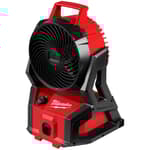
Portable jobsite fan with adjustable head and multiple mounting options. Operates from M18 battery or AC adapter, provides variable speeds and directional airflow for ventilation and cooling.
Milwaukee Jobsite Fan Review
Why I reached for this fan
On muggy remodels and stuffy basements, I’ve learned that a little directed airflow solves a lot of problems—comfort, drying time, and air quality among them. Milwaukee’s M18 jobsite fan quickly became a go-to in my kit because it hits that sweet spot of power, portability, and mounting flexibility that a box fan or desk fan just can’t touch on a worksite.
Airflow and throw
This fan isn’t about brute size; it’s about focused, usable air. On high, it’s rated up to 284 CFM with air velocity up to 18 mph, and that feels about right in the field. The airflow hits as a tight, purposeful stream rather than a diffuse wash, which makes it great for:
- Spot cooling a person at a bench or miter saw
- Pushing fresh air from a clean room into a work zone
- Moving dust-laden air out a window while sanding
- Speeding up drying for joint compound, paint touch-ups, or minor spills
Milwaukee claims it can circulate air over 40 feet. In long hallways and down stairwells, I can still feel that stream move curtains and dust at the far end, so the throw is legit. I wouldn’t use it to replace a whole-room box fan, but for pointed tasks, it’s excellent.
Adjustability and mounting
The head tilts 120° with nine positive stops, and they’re firm enough that vibration never walks the angle out of position. That repeatable “click” lets me set it and trust it, which is more than I can say for most consumer fans with loose pivots.
Mounting is where this thing shines on site. Four keyhole hangers on the back let me:
- Hang it flat to a wall or stud face
- Rotate it for vertical or horizontal airflow
- Secure it upside down under a shelf
The base is broad and low, so it stays planted in a truck bed or on subfloor. I’ve hauled it in the side box of a work truck over washboard dirt roads without it tipping. For tight jobs, being able to set it, aim it precisely, and forget it is worth as much as the airflow itself.
Power options and run-time
The fan runs on any M18 REDLITHIUM battery, which is the main reason I carry it—no new ecosystem, no special packs. On low, Milwaukee rates up to 17 hours with an XC5.0. In real use, low keeps a steady breeze for a full workday and then some. Medium is the workhorse for me: enough push to move air through a doorway while still sipping battery. High is punchy and useful, but expect to swap packs if you’re running it for hours.
There’s also an AC adapter option for continuous runtime. That flexibility is great on longer tasks, but note that the adapter is a wall-wart style brick with a short lead. I keep an extension cord handy because the stubby cord can be awkward when you’re trying to hang the fan and route power neatly. I’d love to see Milwaukee integrate the transformer so a standard IEC or figure-8 cord could plug straight into the housing.
One feature that’s missing: there’s no battery charging when running on AC. It’s purely pass-through power. I understand the design choice, but an integrated trickle charger would push the utility of this fan over the top for shop and trailer setups.
Controls and noise
Three speed settings—Low, Medium, High—are all you get, which keeps things simple and fast. The control feels sturdy and easy to find with gloved hands.
On noise: High is comparable to a compact box fan—audible, but not obnoxious in a jobsite context. Medium is reasonable for indoor use. Low is quiet enough to run in a finished space without raising eyebrows.
I did run into an annoyance over time. After several months, my unit developed a faint rattling on Low that disappeared on Medium or High. Laying the fan on its side stopped it, but that defeats the whole point of the tilt. A quick check of the grille screws and a gentle cleaning helped for a while, but the rattle crept back. It never affected performance, only sanity on quieter tasks. I’ve seen this kind of resonance in compact fans before; it seems to be the trade-off for a small, stiff housing with a decent motor.
Startup is snappy, and there’s a brief mechanical hum from the motor as it spins up—normal behavior and it fades as the bearings settle.
Build and durability
The housing feels like a true jobsite tool: dense plastic with reinforcing ribs, no flimsy trusswork that snaps on first drop. The grille is stout, and the hinge hardware has held its detents after months of regular adjustments. The fan is light enough to carry with a couple of fingers, and it stores easily on a shelf or rafter hook.
That said, I have to flag long-term reliability. One of my units stopped powering on after a bit more than a year of light, intermittent use—no response on battery or AC. I replaced it and my current unit has been fine. Given how fond I am of the performance and form factor, the failure stung. My takeaway is simple: if this fan is mission-critical to your workflow, consider keeping a backup or the AC adapter in the kit for redundancy.
Practical tip: blow the dust out of the grille and motor cavity every few weeks if you’re sanding or cutting near it. Caked dust accelerates wear on the bearings and can throw the blade off balance, which doesn’t help with that low-speed rattle.
Where it excels
- Trades on the move who already run M18 batteries and want targeted airflow without cords
- Spot cooling for bench work, saw stations, crawlspaces, and attics
- Temporary ventilation for drywall sanding, adhesive fumes, or paint touch-ups
- Equipment cooling in enclosed boxes or vans, where a stable base and precise aim matter
Where it falls short
- AC-only shop setups that want a long cord and a standard plug instead of a wall-wart
- Users sensitive to low-speed harmonics; some units develop a rattle you can hear in quiet rooms
- Continuous daily operation where long-haul reliability is non-negotiable
The bottom line
The M18 fan nails the fundamentals that matter on site: focused airflow, flexible mounting, simple controls, and battery compatibility that fits the rest of the kit. It moves air farther than its size suggests, runs long enough on a 5.0Ah pack to cover real work, and the tilt-and-hang options make it more useful than any cheap box fan I’ve owned.
The knocks are practical rather than theoretical: the AC brick with its short cord is clumsy; there’s no integrated charger; and I’ve experienced a low-speed rattle along with one unit that failed earlier than I would expect from a professional brand. None of those are deal-breakers for me, but they are worth knowing before you buy.
Recommendation: I recommend this fan for anyone already invested in M18 who needs portable, directional airflow on jobsites or in a mobile shop. It’s a strong performer with excellent ergonomics that genuinely improves day-to-day work. If you plan to run it on AC most of the time or you demand whisper-quiet operation in finished spaces, you may want to look at AC-native models with longer cords and softer noise profiles. And if uptime is critical, keep a spare battery and consider the AC adapter to hedge against downtime. Despite the caveats, the utility-to-size ratio here is hard to beat, and that’s why it keeps earning a spot in my truck.
Project Ideas
Business
Tool Rental Bundles for Contractors
Offer day/week rentals of the Jobsite Fan with optional battery and AC adapter bundles, mounting kits, and transport cases. Market packages tailored to painters, framers, and roofers who need temporary ventilation or cooling on short jobs, with optional delivery and pickup.
Water Damage & Drying Service
Create a remediation service that uses these fans for rapid drying and airflow control in water-damaged properties or remodeling jobs. Emphasize battery operation for access to power-starved areas, and package the service with moisture monitoring, CRB-filter attachments, and time-based billing.
Event Comfort Rentals
Rent fans for outdoor events — weddings, markets, pop-up restaurants — with attendant setup and battery swap services. Offer tiered pricing (single-fan hire, multi-fan tent packages, overnight runs with AC adapters) and add-on services like operator presence and placement optimization.
Accessory & Retrofit Sales
Develop and sell add-on accessories (battery bundles, quick-mount brackets for trusses, washable filter pockets, weatherproof covers, branded carry solutions). Market them to contractors and rental companies as value-added upsells, or create combo SKUs for specific trades (painters, HVAC, remediation).
Subscription Battery & Maintenance Program
Offer a subscription service that supplies replacement batteries, periodic maintenance, and inspection for fleets of fans used by contractors. This recurring-revenue model reduces customer downtime, ensures peak performance on jobsites, and pairs naturally with rental and service contracts.
Creative
Paint & Finish Drying Station
Create a portable drying station for small furniture and cabinetry by mounting the fan on a collapsible stand or hanging it from a frame. Use the adjustable 120° head and three speed settings to direct airflow precisely over wet surfaces, run on battery for remote shops, and speed cure times while reducing dust settling.
Pop-up Greenhouse Ventilation
Use the fan inside backyard cold frames or pop-up greenhouses to prevent overheating and improve air circulation. The long run-time on an M18 battery or AC adapter lets you maintain temperature control in sunny conditions, and the multiple mounting keyholes make attaching to tent poles or rafters easy.
Dust-Control Sanding Station
Build a compact sanding workstation with the fan aimed to pull dust away from the operator and towards a collection area (add a simple filter or mesh pocket). The 120° adjustable head and lightweight design let you position airflow precisely; battery power lets you use it where shop dust collection can't reach.
Market Stall Cooling & Lighting Combo
Convert the fan into a dual-purpose comfort solution for farmers markets and craft fairs: hang it from your canopy for cool airflow and attach battery-powered LED strips or small battery lights to the mount. Battery operation simplifies setup where power is limited and the fan covers large vendor areas.
Interactive Wind Art / Fog Sculpture
Incorporate one or more fans into a kinetic art piece or outdoor installation—use the adjustable head and multiple fans to shape moving fog from a small fogger or to animate lightweight elements. The portability and variable speeds let you choreograph subtle or dramatic effects for events or gallery shows.