Related Tools


Related Articles
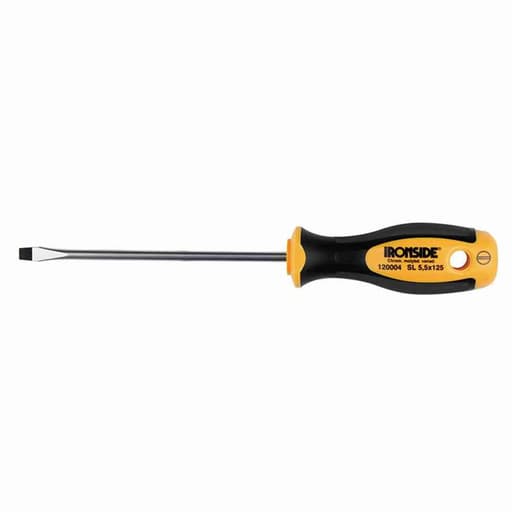
IRONSIDE Flathead Screwdriver Review
Why this flathead earned a place in my kit
I reach for this flathead more often than I expected. It’s the kind of screwdriver that disappears into the workflow because it simply does what it should: bite the slot, turn cleanly, and get into the space you’re working in without drama. After months of use across the bench and in the field—woodworking jigs, electrical terminations, small machine adjustments—it’s proven to be a reliable, no-surprises driver that rewards good technique and doesn’t punish you for pushing a little harder when the fastener resists.
Build and ergonomics
The handle strikes a smart balance between girth and control. It’s large enough to deliver meaningful torque without cramping the hand, yet not so bulky that it blocks access around trim, panels, or tight housings. The surface offers a secure grip even with light gloves; I never had to death-grip it to keep from slipping, which matters when you’re trying to guide the blade into a narrow slot without wobble. The handle’s shape also resists rolling on a benchtop—a small but appreciated detail when you’re juggling parts.
Balance is good. The weight distribution puts the pivot where your palm wants it, so fine adjustments feel steady rather than tippy. On longer runs—think series of terminal screws or cabinet hardware—the handle doesn’t develop hot spots. That tells me the edges and contours are thoughtfully executed rather than cosmetic.
Tip geometry and real‑world fit
The star of this driver is the tip. It’s ground square and true, with parallel faces that seat fully in the slot instead of perching on the edges. On medium slotted fasteners, the width is just right—broad enough to fill the slot and prevent cam-out, but not so wide that it bottoms out prematurely. I measured the blade at roughly 13/32-inch wide and about 1/16-inch thick at the tip, which has been ideal for:
- Threaded wood inserts and hardware adjustments where a crisp, flat blade prevents burring the slot
- Slotted set screws in fixtures and small machines
- Electrical devices and terminal strips that prefer a full-width driver to avoid chewing the slot
More important than the numbers is the grind quality. The corners are sharp enough to transmit torque without slipping, but not knife-edged in a way that would mar softer brass screws on first contact. After repeated use on steel and brass hardware, the blade hasn’t mushroomed or twisted—clear evidence of a sensible heat treat that prioritizes edge retention without becoming brittle.
If you routinely work with very narrow slotted screws (tiny cabinet hinges, instrument hardware), you’ll still want a narrower driver. But for common shop and site tasks, this width hits the sweet spot.
Reach and control
Access is where this flathead quietly excels. The shank length lands in that practical middle ground: long enough to reach recessed fasteners in housings, switch boxes, and deep panels, but not so long that the tip wanders as you start the turn. I’ve had no trouble threading into confined spaces between brackets or past face frames where a bulkier handle would get in the way.
The shaft’s stiffness inspires confidence when leaning into stuck fasteners. There’s minimal torsional wind-up, so your input at the handle translates predictably at the tip. That predictability is noticeable when making small quarter-turn adjustments to set screws or insert alignment—you can feel the movement, not just the resistance.
Durability and maintenance
The finish on the blade and shaft has held up well against moisture and the occasional solvent splash. After plenty of trips in and out of the bag, there’s no orange bloom at the ferrule or along the blade. I make a habit of a quick wipe-down after damp work, and that’s likely helped, but the underlying coating or plating is doing its part.
The handle hasn’t picked up gouges or cracks from being tossed into totes with other steel tools. It cleans easily and doesn’t turn slick with a bit of oil or sweat. I haven’t needed to recondition or stone the tip; it’s resisted rolling and edge wear even after a few stubborn, paint-clogged slots—situations that often deform lesser drivers.
As with any screwdriver, don’t use it as a pry bar or cold chisel. The metallurgy here is tuned for turning, and it rewards you with long life if you keep it in that lane.
What it does well
- Tip engagement: The blade fills common slots properly, transmits torque without cam-out, and protects softer metals from damage when used with a steady hand.
- Ergonomics: Comfortable, controllable handle with enough diameter for torque and enough finesse for delicate adjustments.
- Access: A practical reach that serves both recessed fasteners and tighter spaces around fixtures or cabinetry.
- Longevity: Blade hardness and finish choices combine for a driver that holds geometry and resists corrosion in regular use.
Where it comes up short
- Slot coverage: The blade width is ideal for medium slotted screws and inserts, but it won’t be the right fit for fine instrument screws or oversized industrial slots. That’s not a flaw so much as a sizing reality—plan on pairing it with narrower and wider drivers if your work spans extremes.
- No obvious “wrench assist”: If you habitually break loose painted, large slotted screws with a wrench on a hex bolster, this driver doesn’t invite that technique. In most cases you shouldn’t need it, but it’s something to note if that’s part of your routine.
- Packaging and markings: The size marking could be more prominent. I ended up scribing a tiny mark on the handle cap for quick ID among similar flatheads in a crowded pouch.
Buying advice and who it’s for
If you do any mix of woodworking, electrical, and light mechanical work, this flathead earns a permanent slot. It’s especially useful if you:
- Adjust slotted inserts, locks, or set screws where a square, consistent tip prevents damage
- Service devices with recessed fasteners and need a driver that threads into confined spaces without a stubby’s compromise
- Prefer a handle that balances torque with control and doesn’t fatigue the hand during repeated use
For a minimalist kit, I’d pair this with one narrower flathead and one Phillips (or Pozidriv, depending on your region) to cover most day-to-day needs. If you frequently face seized or paint-bound slotted screws, add a dedicated demolition-style driver for prying and impact taps; keep this one for everything else so the tip stays true.
Maintenance is straightforward: wipe after damp work, don’t abuse it as a lever, and periodically inspect the tip for burrs. If you do nick an edge, a few light strokes with a fine file will refresh the square geometry—though I haven’t needed to do that yet.
The bottom line
This flathead isn’t flashy, and that’s its strength. The tip geometry is correct, the handle is genuinely comfortable, and the reach is practical for real-world jobs. It’s the screwdriver you forget to compliment because it doesn’t get in your way—until you pick up a sloppily ground bargain driver and remember why this one lives at the front of the pouch.
Recommendation: I recommend it. The precise, durable tip and balanced ergonomics make it a dependable everyday driver for medium slotted fasteners, threaded inserts, and general shop work. As long as you pair it with complementary sizes for very narrow or very wide slots, it will handle the bulk of your flathead tasks with ease and longevity.
Project Ideas
Business
Mobile quick-fix handyman service
Offer a neighborhood on-demand service for small jobs that often require just a flathead screwdriver: tighten loose switches/plates, rehang cabinet doors, replace light switch plates, assemble furniture, and minor appliance panel access. Market as a low-cost '15–30 minute fixes' visit with flat hourly or per-task rates. Use booking via SMS or an app and emphasize speed and trustworthiness.
Beginner DIY workshops
Run short classes teaching basic home repairs and tool fundamentals using a flathead screwdriver as the starting tool. Topics: screw/types and drivers, safe prying and leverage, basic wiring plate swaps, and simple furniture assembly. Workshops can be held in a makerspace, library, or pop-up at craft fairs; sell starter kits (screwdriver + small project) alongside tickets.
Custom engraved/tool personalization
Offer personalized, engraved or painted flathead screwdrivers as corporate gifts, wedding favors, or tradeshow swag. Add logos, names, or decorative patterns to handles (wood, metal, or resin). Package in small handcrafted boxes or leather pouches to increase perceived value. Upsell with matching tool cards or maintenance guides.
Starter tool kit subscription box
Curate a monthly subscription aimed at new renters, students, or aspiring makers: each box centers around a quality flathead screwdriver plus complementary mini-tools and micro-projects (e.g., picture-hanging kit, small shelf assembly, emergency repairs). Include how-to cards, short video links, and occasional specialty screwdrivers or handle upgrades to keep subscribers engaged.
Social media repair/how-to content
Create short, punchy videos that demonstrate clever uses for a flathead screwdriver—quick prying tricks, converting tips into specialized tools, or common household fixes. Monetize through ad revenue, sponsorships from tool brands, affiliate links for starter kits, and downloadable quick-reference PDFs. Position content as 'life-hack meets craftsmanship' to attract both DIYers and creative audiences.
Creative
Mini pry-bar sculptures
Collect worn or inexpensive flathead screwdrivers and use the shafts and blades as structural elements to create small industrial sculptures or wall art. Bend and weld (or epoxy) pieces into abstract shapes, tiny trees, or geometric mobiles. The flat blade makes a distinct linear aesthetic; finish with patina, paint, or clear coat. These make striking desk sculptures or gallery-style pieces.
Scraper + burnisher for leather projects
Repurpose the screwdriver tip as a leather skiving/scraping tool and edge burnisher. File the blade to a smooth radius for burnishing seams or to a thin square edge for skiving. Use for making belts, wallets, and straps — the metal edge smooths glue lines and compresses fibers for a polished finish. Great for small shops where a single multi-use tool saves bench space.
Pocket multi-tool conversion
Turn a flathead screwdriver into a compact multi-tool handle: attach a short flat-blade, bottle opener cut into the shank, a small ruler etched along the shaft, and a keyring hole. Encapsulate in a wooden or resin handle carved to be ergonomic. These pocket-sized items are great as practical gifts or craft fair items.
Detail chisel for wood carving and inlay
Grind the screwdriver tip to form a range of chisel profiles (straight, skewed, or V-gouge) for fine inlay or relief work. The sturdy shaft is useful for controlled tapping with a mallet when cutting small mortises or cleaning out tight corners. Make custom-handled sets for marquetry or instrument repair work.
Upcycled hardware: wall hooks & bottle openers
Bend and mount flathead blades onto reclaimed wood blocks or metal plates to make rustic wall hooks or bottle openers. The blade's flat face is perfect for hanging lightweight items or catching bottle caps. Add leather pads or ornamental screws for a finished look; sell as home-decor bundles.