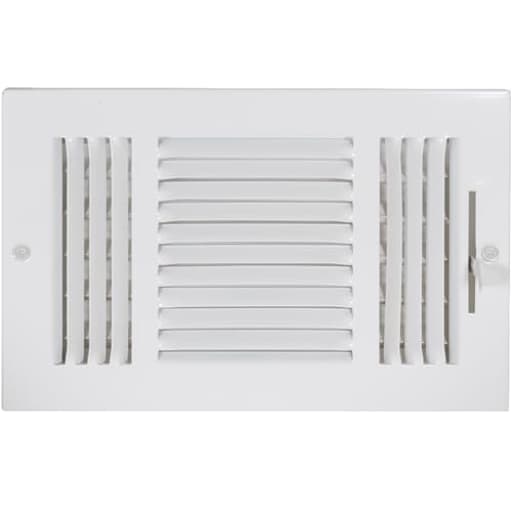
Features
- WALL OR CEILING VENT: 3-way air deflector fits a 10 in. x 6 in. duct opening; overall dimensions measure 11-3/4 in. x 7-3/4 in; inner grille will be about 1/4 to 1/2 in. smaller for a proper fit
- FUNCTIONALITY: Includes 5 adjustable dampers and 19 louvers for quiet, rattle-free operation; controls direction and volume of airflow for efficient ventilation
- DURABLE MATERIALS: All-steel construction with a matte white powder-coated finish; built to maintain performance through heating and cooling cycles
- ENERGY EFFICIENT: Designed for optimal airflow to help improve HVAC system efficiency in both residential and commercial applications
- EASY TO INSTALL: Fits most wall or ceiling openings; comes with 2 screws and installs quickly; features a clean white surface that’s easy to maintain
Specifications
| Energy Efficiency Class | Energy Efficient |
| Color | White |
| Size | 10 in. x 6 in. |
| Unit Count | 1 |
Related Tools
Solid-steel air vent cover for wall or ceiling installation over a 10 in. x 6 in. duct opening (overall 11-3/4 in. x 7-3/4 in.); inner grille is about 1/4 to 1/2 in. smaller for proper fit and two mounting screws are included. The three-way grille has 19 louvers and five adjustable dampers to control airflow direction and volume, and the matte white powder-coated finish is suitable for normal HVAC temperature cycles.
EZ-FLO 10 x 6 Inch (Duct Opening) Air Vent Cover for Wall or Ceiling, Three-Way Ventilation Register, Solid Steel HVAC Register Cover, White, 61614 Review
Why I picked up this register
My home has more than a few tired, paint-clogged registers from the last remodel, and a couple of rooms have never balanced quite right. I swapped one out for the EZ-FLO 10x6 register to see if a simple, inexpensive upgrade could help with airflow control and appearance without introducing noise or rattles. I installed it on both a wall and a ceiling to get a fair sense of how it behaves in different orientations.
Build and design
The register is all steel with a matte white powder-coated finish. It’s a straightforward three-way pattern with 19 louvers and a lever that actuates a set of five dampers inside. The overall face measures about 11-3/4 x 7-3/4 inches, sized to cover a 10 x 6 inch duct opening with a bit of margin for misaligned drywall cuts. The profile is low and clean; the matte coating reads “new construction” rather than glossy touch-up.
The steel gauge is appropriate for wall or ceiling use. It doesn’t flex noticeably when you open and close the damper, and the louver edges are crisp enough that they don’t trap dust more than any other standard register. I wouldn’t put this on a floor—this is not a floor register—but for wall and ceiling it feels robust and tidy.
Installation experience
On a pre-existing wall opening, install was quick. The register ships with two painted mounting screws. The holes line up with standard spacing, and the lip sits evenly without rocking. On a ceiling, I needed to pre-drill pilot holes; ceiling framing and older sheet metal boots can be unforgiving, and the included Phillips-head screws are easy to cam out if you try to muscle them in without a pilot.
A few installation tips that made the process smoother:
- Verify the rough opening is truly 10 x 6 inches. A tape measure check saves time later.
- If the boot isn’t threaded, drill pilots into the sheet metal or backing wood to avoid stripping the screw heads.
- Hand-drive the last turns to keep the finish intact and to avoid over-torqueing into drywall.
- If your opening is irregular, add a thin bead of painter’s caulk or apply a strip of adhesive foam behind the perimeter. It improves the seal and stops minor rattles.
The included screws match the finish and look fine once seated. If you’re working with harder substrates, consider swapping to a self-drilling pan head or using a nut driver with gentle torque to avoid scuffing the heads.
Airflow control and noise
The three-way pattern sends air left, right, and forward, which is a good general-purpose throw for most wall placements. In my living room test, directing the lever halfway closed shifted more volume toward the left and right without ramping up audible hiss. Fully open, the louvers present a generous free area for a register in this size class; the room reached setpoint quicker compared to the nearly-closed, paint-gummed register it replaced.
Noise is low. Even with a strong blower cycle, I didn’t hear chattering or louver buzz. That’s partly the sturdier damper assembly and partly the fit—once the perimeter is snug, there’s little opportunity for vibration. If you do get a tiny ring at certain fan speeds, a thin foam gasket behind the top edge is a reliable fix.
One realistic limitation: “closed” doesn’t mean airtight. Like most residential registers, some leakage persists with the damper closed. If you’re trying to block a register entirely, use a purpose-made magnetic cover or seal the duct upstream. For everyday balancing, the damper here provides a useful and predictable adjustment range.
Fit and sealing
On a clean 10 x 6 opening, the register sits square with even reveal. On a slightly oversized or uneven drywall cut, the wide flange hides sins well. I like the idea of a foam perimeter from the factory, but it’s easy enough to add after the fact if you want a better pressure seal or you’re chasing minor whistling. With a thin foam strip installed, I saw a small reduction in draft around the edges and a perceptible drop in noise on high-CFM runs.
If you plan to mount on a ceiling that’s textured or slightly wavy, a gasket helps the finish look intentional and keeps dust lines from forming.
Durability and finish
The powder coat is consistent, with no thin spots, and it holds up to light handling. The screw heads, being painted, will show wear if you aggressively drive them with a power tool; that’s the tradeoff for color-matched hardware. After a few weeks of heating and cooling cycles, the finish hasn’t discolored or picked up any creaks. Wiping dust is easy—no chalky residue or catching on rough edges.
As with many stamped steel registers, you can bend louvers if you drop it face-down, but normal handling and occasional lever adjustments don’t phase it.
Where it works well—and where it doesn’t
Works well:
- Wall or ceiling supply registers where you want a clean, low-profile look.
- Rooms that need basic directional control to keep air off a wall, curtain, or furniture edge.
- Quick refreshes where you’re replacing a noisy or paint-laden register.
Less ideal:
- Situations demanding zero airflow when “closed.” This is for balancing, not blanking.
- Floor installations—this is not designed for foot traffic.
- High-static systems where the register must withstand frequent slamming pressure changes (it does fine for typical residential systems, but if you’re pushing extreme CFM through small ducts, consider a heavy-duty commercial register).
Practical performance and efficiency
Registers are a small part of an HVAC system, but they do influence comfort and perceived efficiency. On my system, rebalancing with this register reduced the temperature gradient in a problematic room by a couple of degrees without increasing blower noise. That means more of the heat and cooling gets directed where it matters, and the equipment can cycle off sooner. If you combine that with sealing leaks at the boot-to-drywall gap and taping gaps inside the duct, you’ll see the most benefit.
Value
For the price, the EZ-FLO 10x6 register hits a sweet spot: steel construction, matte finish, and a damper that actually stays where you set it. You can spend more for decorative patterns or ultra-quiet curved-blade designs, and you can spend less for flimsy plastic. This one sits comfortably in the dependable middle, which is exactly what many homes need for uniformity and function.
Small gripes
- The included Phillips screws are easy to strip in thick metal or dense backing; pre-drill or bring your own hardware.
- A perimeter gasket would be a nice touch for sealing and noise control.
- If you frequently remove and reinstall registers, the painted screw heads will eventually show wear.
None of these are dealbreakers, and all have straightforward workarounds.
Recommendation
I recommend the EZ-FLO 10x6 register for anyone updating wall or ceiling vents and looking for reliable airflow control, a clean matte finish, and straightforward installation at a reasonable price. It’s solid steel, quiet in operation, and the three-way pattern makes it versatile for most room layouts. While the included screws and lack of a perimeter gasket leave some room for improvement, these are easy to address during install. For everyday comfort and a simple visual refresh, this register is an easy yes.
Project Ideas
Business
Custom Painted Vent Covers Service
Offer a local service painting and finishing vent covers to match trim, cabinetry or seasonal decor for home stagers, interior designers, and Airbnb hosts. Package by room (kitchen bundle, whole-house refresh), include pickup/return and minor repairs; charge per-piece plus miles — quick turnaround and high perceived value for an inexpensive upgrade.
Etsy Shop: Decorative Vent Faceplates
Create an online storefront selling themed, hand-finished vent covers (farmhouse, mid-century, modern metallics). Provide multiple size listings, custom color options, and matching return-air pieces. Use lifestyle photos in-context, target keywords like 'decorative vent cover' and 'HVAC grille art', and offer bundled discounts to increase average order value.
HVAC Retrofit: Smart Damper Add-on
Develop a retrofit kit that mounts a small actuator to the vent's dampers with a wireless thermostat module for room-by-room airflow control. Market to HVAC contractors and energy-conscious homeowners as an upsell — highlight simple install, app-based scheduling and potential energy savings. Offer installation training and a warranty to differentiate from DIY kits.
Seasonal Swap Subscription for Hosts
Sell a subscription service that supplies 2–4 seasonal or holiday decorative vent covers per year to short-term rental hosts and decorators (spring florals, Halloween, winter holidays). Provide easy-swap instructions and optional installation pickup; recurring revenue from subscribers and high retention from hosts who want to refresh interiors with minimal effort.
Creative
Mini Wall Planter
Turn the 10x6 vent into a shallow wall planter: attach a thin waterproof backing and small plastic liner behind the grille, add sphagnum or a moisture-retentive mat and shallow succulents or air plants. The louvers create natural drainage/airflow and the steel frame is strong for hanging — great for kitchens, bathrooms or a vertical herb accent.
Stenciled Decorative Faceplate
Refinish the powder-coated surface with primer and high-adhesion paint, then use stencils or vinyl masks to create a custom pattern (geometric, floral, modern). The adjustable dampers and louvers can be positioned as part of the design. Seal with clear coat for durability — an easy, fast way to swap out standard vents for coordinated room accents.
Shadowbox Photo or Postcard Display
Use the vent as a shallow shadowbox frame: add a simple back panel and clips or magnets to the grille so you can slide in postcards, photos, or small memorabilia. The 11.75 x 7.75 outer size makes a compact rotating gallery you can mount in hallways or craft rooms.
Hidden Key/Mail Nook
Convert the vent into a discreet entryway catch-all: fix a thin hinged box behind the grille (secure with a small latch) so the louvers conceal keys, small mail, or remotes. Keep it shallow so it still fits wall cavities and add a felt lining to protect items — a stylish alternative to a visible hookboard.