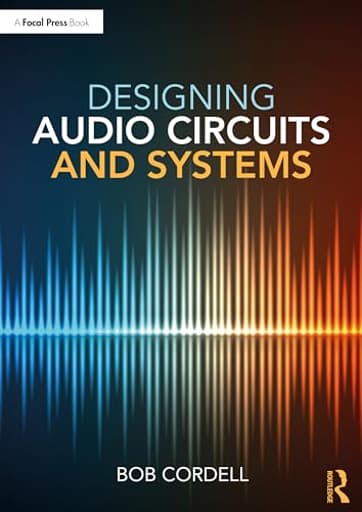
Specifications
| Release Date | 2024-06-12T00:00:01Z |
| Unit Count | 1 |
| Edition | 1 |
| Pages Count | 738 |
| Publication Date | 2024-06-12T00:00:01Z |

This 738‑page first edition (released 12 June 2024) is a technical reference on designing audio circuits and systems. It presents principles and practical guidance on circuit topologies, signal path design, analog and digital interfacing, component selection, measurement, and system‑level integration for audio engineering.
Focal Press Designing Audio Circuits and Systems Review
A month on the bench with Designing Audio Circuits
I spent the past month with Designing Audio Circuits open beside my bench, using it as a working reference while prototyping a couple of small-signal projects—a low‑noise microphone preamp and a VCA‑based compressor. At 738 pages, this first‑edition Focal Press volume (June 2024) is unmistakably a serious, systems‑minded text. It’s not a quick tutorial or a cookbook. It’s a structured tour of how audio circuits fit together, from individual topologies to signal‑path budgeting and system integration, with enough depth to keep an experienced designer engaged.
Scope and organization
Designing Audio Circuits straddles three levels:
- Device and topology: op‑amp stages, discrete gain blocks, VCAs, filters, oscillators, converters, and interfacing circuits.
- Signal‑path practice: gain staging, impedance management, headroom, noise and distortion budgeting, and frequency‑response shaping.
- System integration: grounding and shielding, analog‑to‑digital handoff, clocking considerations, measurement, and maintainability.
The writing is intentionally pragmatic. Equations are present, but they serve design decisions rather than academic derivations. I appreciated that each chapter builds toward checkable criteria—target noise density, loop stability margins, or filter tolerances—so you can move from paper to prototype without guessing what “good” looks like.
Where it helped most
Noise performance and gain planning
I leaned heavily on the chapters covering low‑noise gain blocks and input interfacing. For the mic preamp, the book’s breakdown of source impedance versus input device choice (BJT vs JFET vs instrumentation amp front ends) translated directly into a cleaner design. The guidance on resistor value selection, current‑noise dominance, and the tradeoff between input bias current and noise density helped me hit a realistic EIN target without heroic component choices.
VCAs and dynamics control
While building a feed‑forward compressor, the sections on control law linearity, feed‑through suppression, and side‑chain filtering were immediately useful. The book walks through the failure modes that matter in production—audible control ripple, “zipper” artifacts, and HF dulling from poorly chosen time constants—and lays out the compensations that actually move the needle. I ended up reworking my side‑chain filter after comparing the suggested pole placements with my initial back‑of‑the‑envelope design.
Filters and oscillators
The filter coverage balances classical realizations (Sallen‑Key, MFB) with modern op‑amp constraints. The stability notes for high‑Q stages with real‑world op‑amps and capacitive loads saved me a day of hunting a marginal phase margin problem. The oscillator material is concise but strong on amplitude stabilization tricks that avoid needless distortion.
Interfacing and grounding
Balanced I/O, cable interactions, and shield strategy are handled with practical clarity. The distinction between “functional” and “safety” grounds and the advice on partitioning analog/digital returns are in line with what I’ve learned the hard way. The suggestions for keeping converter reference currents out of sensitive analog nodes are sensible and easy to implement on a two‑ or four‑layer board.
Measurement and verification
There’s an entire thread dedicated to measuring what you’ve built: THD+N, IMD, noise density, and swept performance with typical lab gear. The procedures are good—particularly the pitfalls around windowing, notch filters, and residual analysis when you’re characterizing distortion below 0.001%. I followed the book’s approach to residual‑nulling on my audio analyzer and got reproducible numbers across two bench setups.
If there’s a gap, it’s in the scarcity of step‑by‑step measurement case studies that juxtapose “before/after” spectra or oscilloscope plots for specific design tweaks. The prescriptions are technically sound, but you’ll sometimes wish for more comparative graphs that demonstrate the impact of a layout change or bias adjustment. The measurement chapter gives you the tools; you bring the discipline to apply them.
Component selection guidance
You get thoughtful commentary on op‑amp families, resistor technologies (and where excess noise meaningfully matters), capacitor dielectrics, and diode choices for protection and muting. I liked the nuance around “good enough” parts: the book doesn’t insist on exotic components when a well‑biased, mainstream op‑amp will outperform a boutique device in the same socket. The checklists for input RF filtering, DC‑servo considerations, and turn‑on/turn‑off thumps are particularly actionable.
One thing to note: the op‑amp guidance is technology‑agnostic and principle‑based; you’ll still need to cross‑reference current parts and data sheets to match noise, bandwidth, and output drive to your application.
Digital boundaries and system‑level concerns
The analog‑to‑digital handoff is handled from the analog designer’s perspective: anti‑aliasing filter options, level standards, clock bleed‑through, and power domain isolation. It’s enough to avoid common traps and to spec the right converter support circuits. If you expect deep coverage of DSP or converter architectures, that’s outside this book’s mission, but the hand‑off advice is solid.
On system integration, the PCB layout heuristics are succinct and practical: star points when they’re warranted, planes when they’re cleaner; keep return currents local; split sensitive front ends from switching edges. The emphasis on testability—exposing nodes, allowing for alternate biasing during bring‑up, and leaving room for diagnostics—was a welcome inclusion that many textbooks ignore.
Clarity, usability, and organization
The prose is readable for a technical audience. Equations are accompanied by plain‑language explanations, and figures are clean. Cross‑references between related topics are plentiful, so a question that starts in the preamp chapter often points you to complementary material in the measurement or interfacing sections.
That said, I would have liked to see more worked, end‑to‑end examples with complete schematics, measured data, and a short postmortem. The book often stops just short of “here is the PCB, here is the FFT, here’s what changed when we swapped the bias network.” Experienced readers can fill in those gaps, but it would strengthen the bridge from principle to practice.
Who will get the most from it
- Practicing analog designers and advanced hobbyists who build and measure audio hardware.
- Students past the introductory electronics level who want a guided path from textbook concepts to robust audio circuits.
- Engineers who already own a general reference (like Horowitz and Hill) and want an audio‑specific, system‑level companion.
If you are brand‑new to circuit design or looking for a cookbook of drop‑in schematics, you may find the depth overwhelming and the lack of “instant circuits” frustrating. This is a design reference, not a collection of project recipes.
Practical takeaways I applied immediately
- Treat source impedance as a first‑order design constraint; let it steer your input device selection and resistor values.
- Budget noise and headroom per stage on paper before placing a single component.
- Verify loop stability in the context of real‑world loads, especially with high‑Q active filters and capacitive outputs.
- Measure with intention: null the fundamental, pick a suitable window, and record test setups so results are comparable across benches.
- Keep the analog‑digital boundary clean: defined return paths, filtered rails, and side‑chain filtering that preserves HF detail.
Each of these showed up in my builds as either measurable improvements or time saved during bring‑up.
Verdict
Designing Audio Circuits earns a spot within arm’s reach on my bench. Its strengths are clear: comprehensive small‑signal coverage, actionable design criteria, and a systems view that ties blocks into a coherent, quiet, and stable signal path. It nudged my microphone preamp toward a lower noise floor without exotic parts and helped me correct a compressor side‑chain that was audibly pumping.
The weaknesses are real but manageable: you’ll want more comparative measurement plots than the book provides, and you’ll sometimes wish for complete end‑to‑end builds with annotated lab results. If you’re comfortable running your own experiments—and you should be, if you’re the audience—those gaps won’t slow you down.
Recommendation: I recommend this book to serious audio designers, advanced students, and committed hobbyists who want a rigorous, practice‑oriented reference for small‑signal audio work. It’s not light reading and it’s not a shortcuts manual, but if your goal is to design, measure, and integrate audio circuits with confidence, this first edition is well worth the space on your bench.
Project Ideas
Business
Small‑batch boutique gear brand
Develop a line of limited‑run boutique audio products (tube preamps, headphone amps, passive/active monitors) using the book as the core R&D reference. The book accelerates design validation, BOM selection, EMI/grounding practices, and test procedures. Revenue channels: direct‑to‑consumer sales, limited editions, trade shows and social media marketing.
Technical consulting for indie audio companies
Offer consulting services: circuit audits, prototype design, measurement and compliance guidance, and manufacture‑readiness reviews. The book provides the engineering justification and standards‑level approaches you can present to clients to reduce development cycles and improve product reliability. Charge hourly, per‑project, or retainer fees.
Hands‑on workshops and training courses
Run weekend workshops teaching practical audio circuit design: preamp topologies, active crossover design, measurement techniques and PCB layout best practices. Use the book as a structured curriculum and sell a companion workbook or build‑kit. Monetize with course fees, kit sales, and follow‑up consulting.
DIY kit and PCB storefront
Create polished DIY kits (PCB, BOM, case hardware, detailed assembly/test guide) based on reliably working circuits from the book. Sell kits via an online store and marketplaces. Offer tiered products (beginner kits, pro kits with curated components) and value‑add services like preassembled units or calibration certificates.
Measurement, alignment and calibration studio
Set up a local service for speaker alignment, pro‑audio equipment calibration, and studio tuning. Use the book’s measurement and system‑level chapters to establish professional test procedures and reporting formats. Revenue sources include one‑off calibrations, maintenance contracts with studios, and remote consulting backed by delivered measurement reports.
Creative
Boutique tube preamplifier build
Design and build a hand‑wired single‑channel tube preamp (or a matched stereo pair) with selectable EQ voicings. Use the book for tube circuit topologies, power‑supply design, loading/impedance matching, choke/transformer selection, and measurement procedures to dial in noise, gain and harmonic character. Result is a unique, high‑value piece of studio gear or a showpiece for exhibitions.
Active two‑way powered bookshelf speakers
Create a compact, powered speaker system with active crossover, separate amplifier modules, and DSP input. Leverage the text for speaker crossover topologies, interfacing analog and digital domains, thermal/mechanical considerations, and measurement techniques (impulse response, FR, distortion) to optimize cabinet tuning and crossover alignment.
High‑performance headphone amp with crossfeed and balanced outputs
Build a portable or desktop solid‑state headphone amplifier that supports balanced output, headphone protection, and adjustable crossfeed for a more natural stereo image. Use the book to choose op‑amps/output stages, design low‑noise power supplies and level‑control circuits, and to implement reliable protection and measurement/verification procedures.
Modular Eurorack panel series (VCA, filter, mixer)
Design a small series of analog Eurorack modules (VCA, resonant filter, analog mixer) that emphasize audio quality and stability. Apply the book’s guidance on low‑noise layouts, CV interfacing, precision gain staging, and component selection to produce rugged, musical modules suitable for sale or modular rigs.
Mic preamp + vintage‑style EQ 1U rack combo
Combine a low‑noise mic pre with a discrete, vintage‑inspired equalizer in a single 1U rack unit for project studios. Use the book for transformer vs. transformerless topology tradeoffs, phantom power and grounding schemes, discrete EQ circuit design, and measurement/calibration methods to ensure transparency and repeatability.